







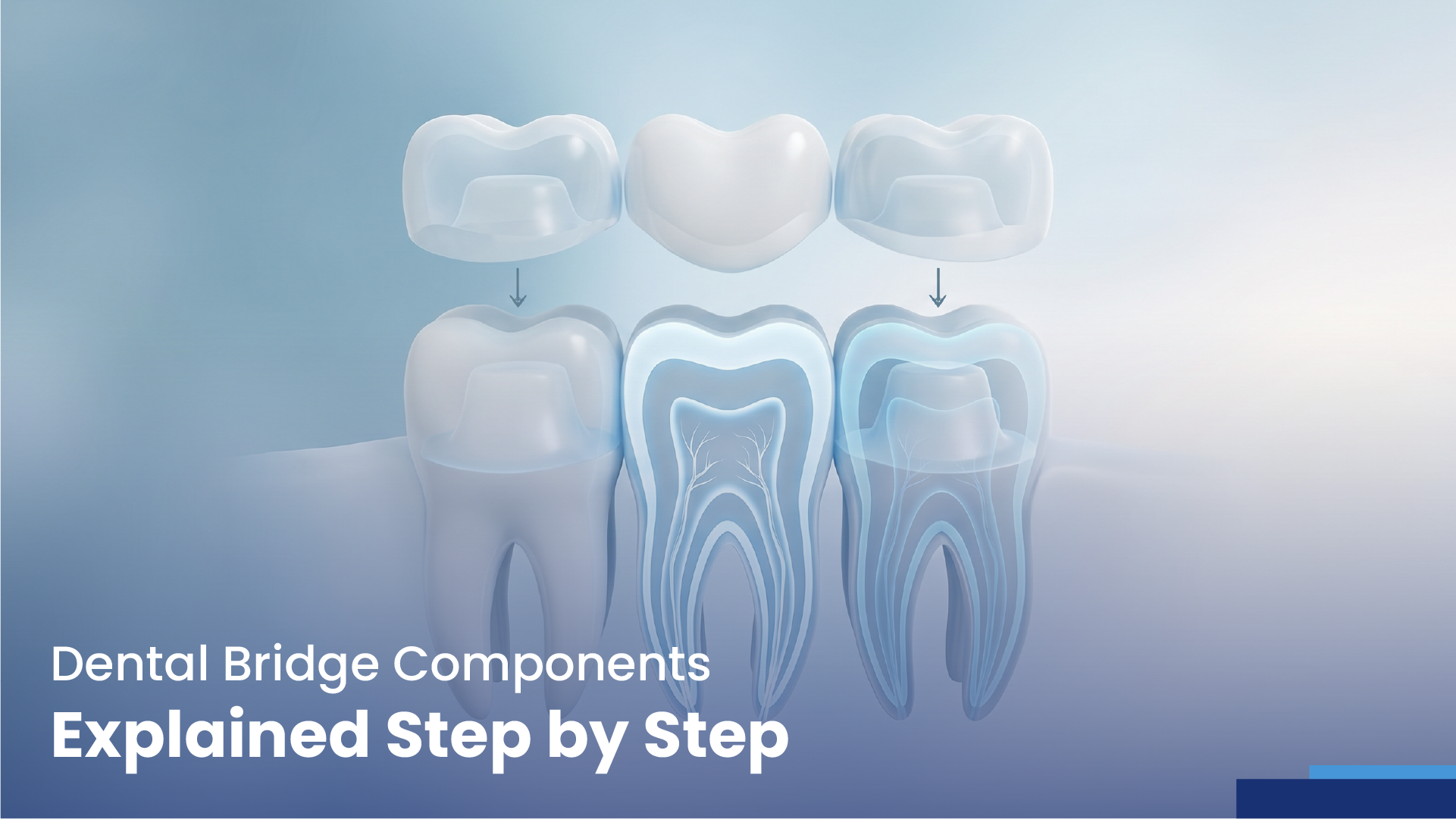
A dental bridge is one of the most established and reliable solutions for replacing a missing tooth or a small group of adjacent missing teeth. Yet many patients begin treatment without a clear understanding of what a bridge actually consists of, how each part functions, or why the procedure works the way it does. Knowing the components helps you understand the treatment, ask better questions, and make a more informed decision.
In this article, we will cover dental bridge components in detail, the different types of bridges and how their components vary, the materials used, the step-by-step procedure, how bridges compare to dental implants, and what to consider when deciding whether a bridge is the right option for your situation.
What Is a Dental Bridge?
A dental bridge is a fixed prosthetic device that literally bridges the gap created by one or more missing teeth. It is anchored to the natural teeth on either side of the gap, or in some designs to dental implants. Once placed, a bridge is cemented in position and functions as a permanent part of the mouth for daily biting, chewing, and speaking. Unlike removable dentures, a bridge stays in place at all times.
Bridges are used when a tooth has been lost to decay, injury, or extraction and there are healthy adjacent teeth or implants available to support the restoration. A full overview of what is covered under restorative dental care is available on our prosthodontics page, which includes bridges, crowns, and other fixed and removable options.
The Dental Bridge Components Explained
The Abutment Teeth
The abutment teeth are the natural teeth on either side of the gap that anchor the bridge in place. These are the load-bearing supports of the entire structure. Before a bridge can be fitted, the abutment teeth must be prepared by reducing a portion of their enamel so that the crowns placed over them fit accurately and securely without adding unwanted bulk to the bite.
The health and strength of the abutment teeth are critical. If they are weakened by decay, large fillings, or periodontal damage, they may not be suitable to carry the added load of a bridge. In some cases, underlying issues such as root canal treatment may need to be completed on abutment teeth before the bridge work begins, to ensure they are structurally sound enough to support the restoration long-term.
The Pontic
The pontic is the artificial tooth that occupies the gap in the dental arch. It is the visible replacement tooth that restores the appearance and function lost when a natural tooth is missing. The pontic is suspended between the two supporting crowns and sits either resting on the gum tissue or positioned just above it, depending on the design and the patient’s anatomy.
The shape, size, and color of the pontic are matched carefully to the surrounding natural teeth so that the bridge looks as natural as possible. According to dental restoration research, pontic design affects both aesthetics and hygiene outcomes, and selecting the right form for each patient and location is an important part of the treatment plan. Our team at Blue Clinic takes care in planning each restoration to suit the individual patient.
The Dental Crowns
The crowns are the cap-shaped structures that are placed over the prepared abutment teeth. They encase the tooth completely down to the gum line and are what physically connects the bridge to the natural teeth. The crowns provide the primary retention that holds the bridge securely in place against the forces of chewing.
The crowns that anchor a bridge are identical in construction to standalone dental crowns used to restore damaged teeth. Understanding the different crown materials available is useful when planning a bridge, as the same options apply. Our guide on types of dental crowns covers the differences between metal, porcelain-fused-to-metal, all-ceramic, and zirconia crowns in detail.
The Framework or Substructure
The framework is the internal structural core that supports the visible porcelain or ceramic outer layer in many bridge designs. It runs continuously beneath the surface from one crown through the pontic and into the other crown, keeping the entire restoration as a single connected unit. In metal-ceramic bridges, this framework is made from metal alloy. In fully ceramic or zirconia bridges, the framework material is the ceramic itself, eliminating metal entirely.
The strength of the framework determines the durability of the bridge. Bridges in the posterior region of the mouth, where biting forces are strongest, may require a stronger material such as zirconia or metal-ceramic rather than a purely porcelain construction. Your dental specialist will select the most appropriate material based on the location, expected load, and your aesthetic requirements.
Types of Dental Bridges and How Their Components Differ
Traditional Fixed Bridge
This is the most common type. It uses two abutment crowns anchored to prepared natural teeth on either side of the gap, with one or more pontics suspended between them. All three elements form a single fused unit that is cemented onto the prepared abutment teeth. This design is reliable for single-tooth gaps and where both neighboring teeth are available and healthy. Our crowns and bridges page provides further information on what this treatment involves at Blue Clinic.
Maryland Bridge
The Maryland bridge, also called a resin-bonded bridge, is a more conservative design. Instead of full crowns on the abutment teeth, it uses thin metal or ceramic wings that are bonded to the back surfaces of the neighboring teeth. This means the natural teeth require little to no preparation. The trade-off is that the bond strength is lower than that of a cemented crown, and Maryland bridges are generally best suited to the front teeth where biting forces are lighter.
This approach is particularly useful for younger patients where preserving tooth structure is a priority, or as a temporary solution while a more permanent option is being planned. Tooth structure preservation is an increasingly important consideration in modern restorative dentistry.
Cantilever Bridge
A cantilever bridge is supported by a crown on only one side of the gap rather than both. This design is used when there is only one natural tooth available adjacent to the missing tooth. It is less commonly recommended because the single anchor carries greater mechanical stress, and the risk of complications such as crown loosening or fracture of the abutment tooth is higher. Most dentists reserve this design for front teeth where forces are lower.
Implant-Supported Bridge
An implant-supported bridge replaces the prepared natural teeth entirely with dental implants as the anchor points. This approach is used when the adjacent natural teeth are not suitable for abutments, or when multiple consecutive teeth are missing and a long-span restoration is needed. Implants are inserted into the jaw and allowed to integrate with the bone over several months before the bridge is attached.
Implant-supported bridges preserve more of the natural tooth structure around the gap and tend to have excellent long-term outcomes. They are generally the preferred solution when suitable, though they involve a longer treatment timeline and higher cost than a conventional bridge.
What Materials Are Used in Dental Bridges?
Dental bridges can be fabricated from several materials depending on the location in the mouth, the aesthetic requirements, and the patient’s bite strength. All-metal bridges are rarely used today outside of heavily loaded posterior areas due to their appearance. Porcelain-fused-to-metal bridges combine a metal inner framework with an outer porcelain layer that mimics tooth color, offering a balance of strength and aesthetics.
All-ceramic and zirconia bridges are now widely used in visible areas of the mouth. Zirconia in particular has become the material of choice in many clinics for its combination of natural appearance, high strength, and biocompatibility. Your restorative dentist will recommend the most appropriate material based on the location of the bridge and the specific demands of your case.
The Dental Bridge Procedure: Step by Step
The process typically begins with an examination and treatment planning appointment. Your dentist will assess the health of the abutment teeth, take X-rays, and may recommend any preparatory treatment before proceeding. If extractions are needed beforehand, see our guide on tooth extraction and recovery.
At the preparation appointment, the abutment teeth are shaped under local anaesthesia to accommodate the crowns. Impressions or digital scans are taken and sent to a dental laboratory where the bridge is custom-fabricated. A temporary bridge is fitted to protect the prepared teeth while the final restoration is made. This stage typically takes one to two weeks.
At the final fitting appointment, the temporary bridge is removed and the permanent bridge is trial-fitted to check the bite, appearance, and marginal fit before cementing. Minor adjustments are made as needed. Once both patient and dentist are satisfied, the bridge is permanently cemented in place. Our dental care team will guide you through everything to expect after placement.
How Long Does a Dental Bridge Last?
A well-made dental bridge, properly cared for, can last 10 to 15 years or longer. Lifespan depends on the quality of the fabrication, the materials used, the condition of the abutment teeth, and how well the patient maintains oral hygiene. The area under and around the bridge requires consistent cleaning with floss threaders or interdental brushes to prevent plaque build-up that could damage the abutment teeth or gums over time.
Regular professional check-ups allow the dentist to monitor the condition of the bridge and the underlying teeth. If the abutment teeth develop decay or gum problems, the bridge may need to be replaced earlier. Our periodontic services can support gum health during and after bridge treatment.
Dental Bridge vs Dental Implant: Which Is Better?
This is one of the most common questions in restorative dentistry. A dental bridge is faster, less invasive, and more affordable than an implant. It does not require surgery or a healing period, and the total treatment time is measured in weeks rather than months. For patients who need a quicker solution or who are not candidates for implant surgery, a bridge is a well-established and effective option.
A dental implant replaces the root of the missing tooth as well as the visible crown. This preserves the jawbone, does not require modification of adjacent teeth, and tends to offer longer-term durability when successful. The trade-off is cost, surgical involvement, and a treatment timeline of several months. Our types of dental bridges guide also touches on how bridges compare to other replacement methods.
Neither option is universally superior. The right choice depends on your oral health, how many teeth are missing, the condition of adjacent teeth, bone quality, timeline, and budget. A consultation with a restorative dentist is the starting point for any tooth replacement decision.
Frequently Asked Questions
Do the abutment teeth get damaged by a bridge?
The abutment teeth are shaped down to accommodate the crowns, which is irreversible. This is why some patients prefer implants, which avoid modification of adjacent teeth. However, in cases where the abutment teeth already have large restorations or are at risk of future treatment, a bridge can be a practical choice that uses those teeth productively.
Is getting a dental bridge painful?
The preparation of the abutment teeth is done under local anaesthesia, so the procedure itself should not be painful. Mild sensitivity or discomfort in the days following preparation is normal and typically resolves on its own. The final cementation appointment is straightforward and generally painless.
How do I clean under a dental bridge?
Cleaning under the pontic is essential and requires specific tools. A floss threader or superfloss allows you to thread regular floss beneath the bridge. Water flossers are also highly effective. Your dentist or hygienist will demonstrate the correct technique at your fitting appointment and during subsequent check-ups.
Can a dental bridge be replaced if it fails?
Yes. If a bridge fails due to cement loosening, a broken pontic, or damage to an abutment tooth, it can in many cases be replaced. Whether an existing bridge can be recemented or needs full replacement depends on the condition of the components. Your dentist will assess the situation and recommend the appropriate course of action.
What is the cost of a dental bridge in Kuwait?
Bridge costs vary depending on the number of units in the bridge, the material used, and the specific clinic. A detailed breakdown of what influences pricing is available in our guide on dental bridge cost in Kuwait. Getting a formal treatment plan from your restorative dentist is the most accurate way to understand the total cost for your situation.
Is a dental bridge permanent?
A dental bridge is considered a long-term fixed restoration rather than a fully permanent one. It is cemented in place and not removed by the patient, but it has a finite lifespan and may eventually need replacement. With proper care, most bridges last 10 to 15 years or more before any intervention is needed.
Understanding Your Options Before Choosing a Bridge
A dental bridge is a well-established, functional, and reliable solution for tooth replacement. Understanding what each component does, which design suits your situation, and what the procedure involves puts you in a much stronger position to make a confident decision alongside your dentist. The right choice depends on the number of missing teeth, the health of adjacent teeth, your timeline, and your long-term goals for your oral health.
Before proceeding, consider the following practical steps:
- Book a consultation with a restorative dentist to assess whether your abutment teeth are suitable and which bridge design is recommended for your case.
- Ask about material options and how each one performs in your specific location in the mouth.
- Discuss whether a dental implant might be a better long-term investment before committing to a bridge.
- Request a full breakdown of the procedure, timeline, and associated costs so you can plan appropriately.
- Contact Blue Clinic through WhatsApp to arrange a consultation with our restorative dentistry team.
Our dental team at Blue Clinic provides comprehensive restorative treatment including crowns, bridges, implants, and full smile rehabilitation. Reach out to arrange a visit and discuss the right solution for your needs.