



Choosing the right hair removal method comes down to four things: how long you want results to last, how much discomfort you are willing to tolerate, what skin and hair type you have, and what you are willing to spend. At Blue Clinic, our dermatology and aesthetics team offers professional laser hair removal as the most clinically effective long-term option, with the expertise to advise which approach makes sense for your specific situation.
This complete guide for 2026 covers every significant hair removal type, from temporary at-home options to long-term professional treatments, with an honest assessment of what each delivers, what it costs, and who it suits best.
How Hair Removal Methods Are Classified
Hair removal methods fall into three broad categories based on how long results last. Temporary methods remove hair at or near the surface, with regrowth typically within days to a week. Root-removal methods pull or damage the follicle enough that regrowth takes two to four weeks. Long-term reduction methods damage the follicle’s ability to produce new hair at all, producing results that last months to years. Only electrolysis is classified as permanently destructive to the follicle in all cases.
Understanding these categories helps set realistic expectations before choosing a method. A method that requires maintenance every few days is very different in practical terms from one that requires a session every few months or a once-yearly top-up after an initial course.
Temporary Hair Removal Methods
Shaving
Shaving cuts hair at the skin surface using a razor blade. It is the fastest, cheapest, and most widely used method globally. Results last one to three days depending on the area and individual hair growth rate. Shaving does not alter the follicle and does not change hair thickness or growth rate — the common belief that shaving makes hair grow back coarser is a myth. The blunt cut end of regrown hair feels coarser than the tapered tip of uncut hair, but the hair itself is unchanged.
Razor bumps (pseudofolliculitis barbae) are a common issue for patients with curly or coarse hair, particularly in the beard area. Long-term laser hair removal is the most effective solution for recurring ingrown hair problems.
Depilatory Creams
Depilatory creams contain alkaline chemicals that break down the disulfide bonds in keratin, dissolving the hair just below or at the skin surface so it can be wiped away. Results last two to five days before regrowth is visible. Depilatory creams are painless but carry a risk of chemical burns if left on too long, particularly on sensitive skin. Different formulations exist for different body areas — facial formulas contain lower chemical concentrations than body formulas. Always perform a patch test 24 hours before full application.
Epilation
Electric epilators use rotating mechanical tweezers to grip and pull multiple hairs simultaneously at the root. Results last two to four weeks. Epilation is painful on first use but many people find discomfort decreases as the skin adapts. It is suitable for most body areas and works on hair as short as 0.5mm, making it more convenient than waxing. It is not generally recommended for facial use due to the pain level and the precision required.
Root-Removal Hair Removal Methods
Waxing
Waxing is one of the most widely used hair removal methods globally. Hot or warm wax is applied to the skin and pulled away quickly, removing hairs at the root. Soft strip wax requires a fabric or paper strip to remove; hard wax hardens on its own and is removed without a strip, making it gentler and better suited to sensitive areas. Results from waxing last two to four weeks before regrowth becomes visible. Waxing requires hair to be a minimum of 6mm long to give the wax something to grip.
Patients using topical retinoids, AHA/BHA acids, or certain acne medications should avoid waxing the affected areas as the skin is more fragile and prone to lifting. For our guide to full body laser as an alternative to ongoing waxing, see our dedicated cost and treatment breakdown.
Threading
Threading uses a twisted cotton thread manipulated by a practitioner to trap and remove hairs at the follicle level in precise rows. It originated in South Asia and the Middle East and remains particularly popular for eyebrow shaping and upper lip hair removal. Threading is highly precise, involves no chemicals or heat, and is appropriate for very sensitive skin and patients who cannot wax due to medication contraindications. Results last two to four weeks. The technique requires skill to execute well — results vary significantly by practitioner.
Long-Term Hair Reduction Methods
Laser Hair Removal
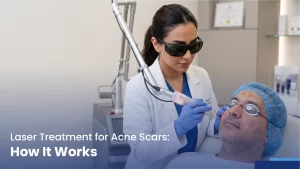
Laser hair removal is the most effective and most widely used professional hair removal method for long-term reduction. It works by targeting the melanin (pigment) in the hair follicle with a specific wavelength of concentrated light. The absorbed energy converts to heat, damaging the follicle’s reproductive capacity. Hair in the active growth phase (anagen) is most susceptible, which is why multiple sessions spaced weeks apart are required.
Clinical evidence from studies in the Journal of the European Academy of Dermatology and Venereology consistently documents 70 to 90 percent long-term hair reduction following a full treatment course. Different laser wavelengths are used depending on skin tone: Alexandrite (755nm) for fair to olive skin, diode (810nm) for a broad range of skin tones, and Nd:YAG (1064nm) as the safest and most effective option for dark skin tones. For pricing information, our laser hair removal cost guide covers what to expect.
Laser: How Many Sessions and What Areas
Most body areas require six to eight sessions spaced four to eight weeks apart for the initial treatment course. Hormonal areas such as the chin and upper lip may require more sessions due to ongoing hormonal influence on follicle activity. Areas such as the underarms, legs, and bikini line typically respond well within a standard course. Between sessions, treated hairs shed gradually over one to three weeks and the skin should be protected from sun exposure.
IPL (Intense Pulsed Light)
IPL uses a broad-spectrum flash of light rather than a single coherent wavelength. Like laser, it targets melanin in the follicle to produce a heating and damage effect. IPL is less precisely targeted than laser because the broad spectrum distributes energy across multiple wavelengths rather than concentrating it at the most effective one for follicle targeting. Professional-grade IPL in clinical settings produces meaningful hair reduction for fair to medium skin tones with dark hair. IPL is generally less effective than dedicated laser systems for coarser hair and darker skin tones. At-home IPL devices produce inferior results due to significantly lower energy outputs.
Electrolysis
Electrolysis is the only hair removal method recognised as producing permanent destruction of the hair follicle. A fine probe is inserted into each individual follicle and an electrical current destroys the follicle’s growth cells. Because each follicle must be treated individually, electrolysis is time-consuming — a single session typically treats a small area over 30 to 60 minutes.
Electrolysis is suitable for all hair colours including grey, white, blonde, and light red — hair colours that lack the melanin needed for laser or IPL to work. It is appropriate for all skin tones. For patients who have completed a laser hair removal course and have residual light-coloured hairs remaining, electrolysis is the appropriate follow-up. The aesthetics team at Blue Clinic can advise on whether laser, electrolysis, or a combination approach best suits your situation.
Laser vs IPL: Which Is Better?
Laser hair removal consistently outperforms IPL in clinical studies across most patient populations. Laser produces a more concentrated and precisely targeted energy delivery that generates more effective follicle damage per session. IPL remains a valid option for patients with fair to olive skin tones and dark hair, particularly when performed on professional-grade systems by experienced practitioners.
For patients primarily seeking effective hair reduction with the most robust clinical evidence, laser is the clear recommendation. At-home IPL is significantly inferior to both professional laser and professional IPL in terms of efficacy. According to the American Academy of Dermatology, professional laser hair removal remains the most evidence-supported option for long-term hair reduction across a broad patient population.
The Role of Skin Tone and Hair Colour in Choosing a Method
The most important variables in selecting a professional hair removal method are your Fitzpatrick skin type and your natural hair colour:
- Fair skin (Fitzpatrick I–II) with dark hair: Alexandrite or diode laser — best results
- Medium skin (Fitzpatrick III) with dark hair: diode or Nd:YAG laser — excellent results
- Olive skin (Fitzpatrick IV) with dark hair: Nd:YAG laser, caution with IPL — good results
- Dark skin (Fitzpatrick V–VI) with dark hair: Nd:YAG laser only — requires experienced practitioner
- Any skin tone with light, grey, or white hair: electrolysis only — laser and IPL ineffective
Having your skin type assessed by a trained practitioner before starting laser or IPL treatment is essential, not optional. Our dermatology team at Blue Clinic performs a full Fitzpatrick assessment as part of every laser consultation.
Cost Comparison Across Hair Removal Types
- Shaving: minimal upfront cost, daily to weekly maintenance required
- Depilatory creams: low per-use cost, required every few days
- Threading: low per-session cost, required every 2–4 weeks
- Waxing: moderate per-session cost, required every 3–6 weeks
- IPL (professional): moderate per-session cost, 6–8 sessions for initial course, annual top-ups
- Laser (professional): higher per-session cost, 6–8 sessions for initial course, infrequent top-ups — lowest long-term maintenance cost
- Electrolysis: high per-hour cost, time-intensive, but permanent for treated follicles
When considered over a five-year period, professional laser hair removal typically costs less in total than ongoing waxing or threading at comparable quality clinics, in addition to delivering far superior long-term results. Our full body laser cost guide illustrates the long-term value comparison in more detail.
Frequently Asked Questions
Which hair removal method lasts the longest?
Electrolysis is the only method that permanently destroys individual follicles. Laser hair removal produces the longest-lasting reduction for dark hair — most patients see results lasting years after completing a full course. All other methods produce temporary results ranging from days to weeks.
Is laser hair removal painful?
Most patients describe the sensation as a rubber band snap or a brief warm sting with each pulse. The discomfort varies by area — bony areas and more sensitive skin regions tend to feel more intense. Cooling devices built into professional laser systems significantly reduce discomfort. The sensation is tolerable for most patients and improves as treatment progresses and hair becomes sparser.
How long does a laser hair removal session take?
Session duration depends entirely on the area being treated. Small areas such as the underarms take five to ten minutes. The full legs take 45 to 60 minutes. Sessions are spaced four to eight weeks apart depending on the body area and hair growth cycle.
Can I shave between laser sessions?
Yes, shaving between sessions is recommended. Waxing, threading, and plucking during a laser course are not recommended because they remove the hair root that the laser needs to target. Shaving leaves the root intact while keeping the surface hair short, which is ideal.
Does laser hair removal work on ingrown hairs?
Yes, laser hair removal is the most effective treatment for chronic ingrown hair problems. By reducing hair density and disrupting the follicle’s ability to produce hair, it eliminates the source of the problem permanently over the course of treatment. It is particularly effective for pseudofolliculitis barbae in the beard area and recurring ingrown hairs in the bikini region.
Find the Right Hair Removal Approach for You
The right method depends on your skin tone and hair type, the area you want treated, your budget, and how much ongoing maintenance you want to manage. For most patients seeking the best long-term result with the least ongoing effort, professional laser hair removal at a clinic with appropriate technology and trained practitioners is the clear recommendation.
Practical next steps:
- Review our laser hair removal pricing and session guide for detailed information on costs and what a full treatment course involves.
- Visit the Blue Clinic dermatology and aesthetics page to learn about our laser systems and practitioner expertise.
- Book a consultation through WhatsApp for a skin type assessment and personalised recommendation for your specific hair and skin combination.
Our team at Blue Clinic will give you an honest assessment of which method will work best for your individual profile and realistic expectations for results.