



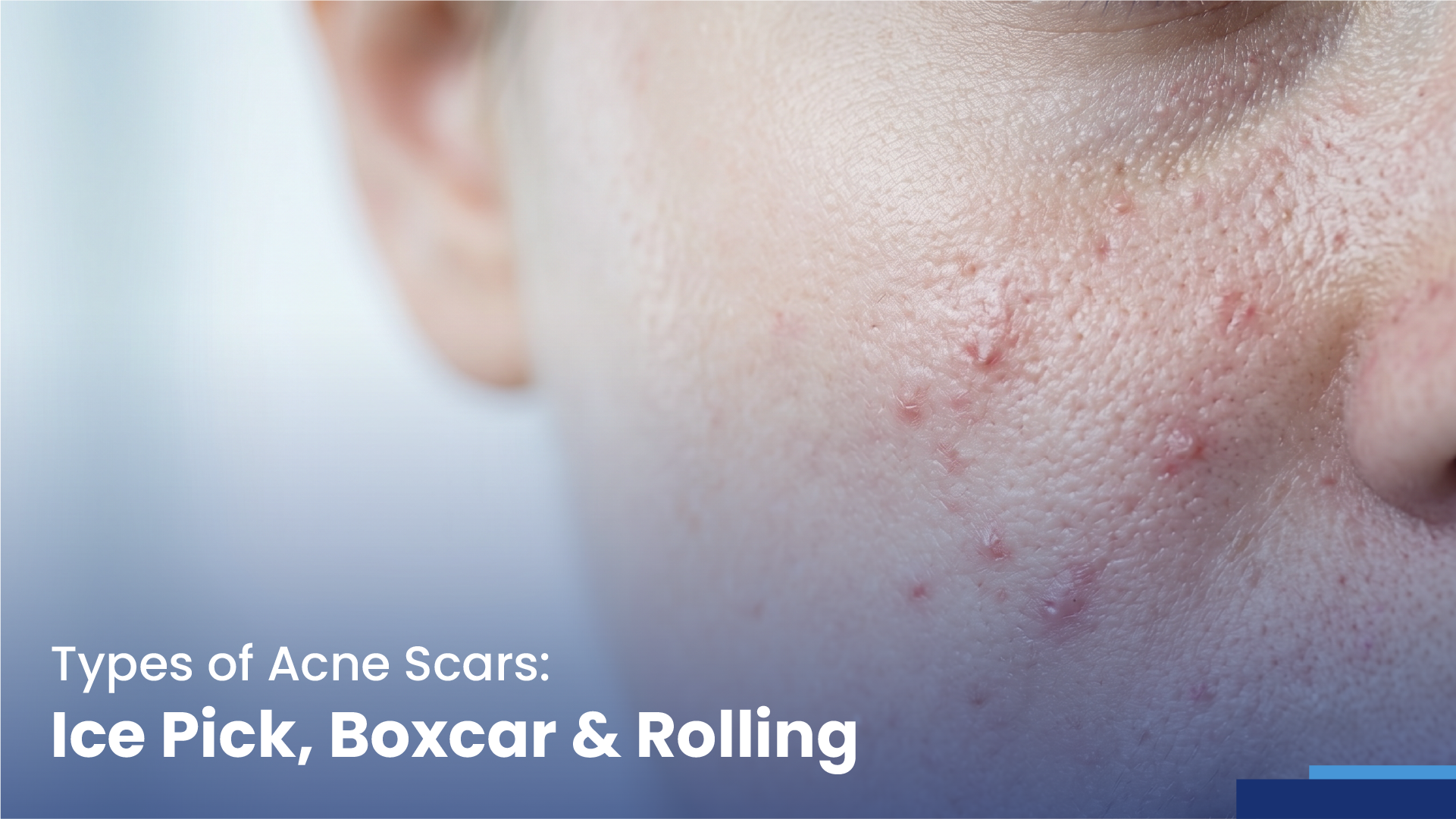
Not all acne scars are the same, and this matters because the type of scar largely determines which treatment will work. A procedure that dramatically improves rolling scars can have minimal effect on ice pick scars, and vice versa. People spend significant time and money on treatments that produce disappointing results because the approach was mismatched to the scar type. Understanding the structure and appearance of your specific scars is the starting point for choosing treatment that actually delivers. The dermatology team at Blue Clinic assesses scar type and distribution before recommending any treatment approach.
This guide covers all the main types of acne scars — how they form, what they look like, how to distinguish one from another by examining your own skin, and which scar types respond to which treatments.
How Acne Scars Form
A scar forms when a breakout damages the dermis, the layer of skin beneath the surface that contains collagen. When the inflammatory process of a papule, nodule, or cyst destroys collagen, the skin attempts to repair itself. The type of scar that results depends on whether this repair produces too little collagen (leaving a depression) or too much collagen (leaving a raised area). The depth and severity of the original inflammation, the patient’s genetic tendency to scar, and whether the breakout was squeezed or picked all influence which scar type develops.
Importantly, post-inflammatory hyperpigmentation (the dark marks left after a breakout resolves) and post-inflammatory erythema (the flat red marks) are often mistakenly called scars. They are not true scars — they are pigment or vascular changes that tend to fade over time, even without treatment. True scars involve a change in skin texture and structure that does not resolve on its own. According to research in the Journal of Clinical and Aesthetic Dermatology, correctly categorising the type of acne sequelae is the most important step in effective treatment planning.
Atrophic Scars: The Depressed Types
Atrophic scars are depressions in the skin surface caused by insufficient collagen production during healing. They are by far the most common type of acne scar. There are three distinct subtypes, each with a different structure and a different response to treatment.
Ice Pick Scars
Ice pick scars are narrow, deep, and sharply defined. They extend down into the dermis or even into the subcutaneous fat, giving them their name: they look as if the skin has been pierced with an ice pick, creating a small, steep-sided pit. The opening at the surface is small, typically less than 2mm, but the depth can be considerable.
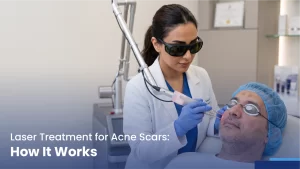
They are among the most difficult acne scars to treat precisely because of that depth. Treatments that work on the surface — lasers, chemical peels, microneedling — do not penetrate deeply enough to address the base of the scar. Ice pick scars are best treated with techniques designed for their specific structure: punch excision, where the entire scar column is surgically removed and the tiny wound sutured closed, or TCA CROSS (trichloroacetic acid chemical reconstruction of skin scars), where high-concentration TCA is carefully applied inside the scar to trigger collagen formation deep within the pit. After either approach, the residual mark is then addressable with resurfacing.
Boxcar Scars
Boxcar scars are wide, oval or round depressions with sharply defined, near-vertical walls — like a box or a stamp impression in the skin. Their defining feature is the crisp, clearly demarcated edge, which distinguishes them from rolling scars. They can be shallow (0.1-0.5mm) or deep (more than 0.5mm), and shallow boxcar scars generally respond much better to treatment than deep ones.
Boxcar scars form most commonly on the cheeks and temples. Because they have definable edges and a measurable depth, they respond well to a range of treatments. Fractional laser resurfacing, both ablative and non-ablative, can significantly improve them by stimulating collagen production within the scar walls. Subcision — a procedure where a needle is passed beneath the scar to release the fibrous bands tethering it down — is useful for deeper boxcar scars. Chemical peels and microneedling contribute to gradual improvement across multiple sessions.
Rolling Scars
Rolling scars create an undulating, wavy surface texture rather than the sharp-edged depressions of ice pick and boxcar scars. They form when fibrous bands of tissue tether the skin surface to the deeper structures below, pulling the skin downward in some areas and allowing it to remain at normal height in others, creating a rolling or wave-like appearance.
Rolling scars tend to be the most responsive to treatment among the atrophic scar types. Their characteristic feature is that they often look more pronounced when the skin is stretched — pulling the skin taut makes the tethering and the wave pattern more visible. This is also a clue to the most effective treatment: subcision, which releases the fibrous bands causing the tethering, can dramatically improve rolling scars, sometimes producing visible improvement after a single session. Combined with microneedling or laser for surface texture improvement, rolling scars can be reduced substantially. PRP injected after subcision may further enhance the collagen response.
Hypertrophic and Keloid Scars
Where atrophic scars result from too little collagen, hypertrophic and keloid scars result from too much. These are raised rather than depressed.
Hypertrophic Scars
Hypertrophic scars are firm, raised, often pink or red, and remain within the boundaries of the original wound or breakout. They result from excess collagen deposition during healing. On the face, they are less common from acne than atrophic scars, but they can occur particularly in certain skin tones that are more prone to this healing pattern. Intralesional corticosteroid injections, which suppress collagen production, are the cornerstone of treatment. Silicone-based products applied topically can also help flatten and soften them.
Keloid Scars
Keloids are a more aggressive form of excess scarring where the scar tissue extends beyond the original wound boundary, growing larger than the original site of inflammation. They are more common in darker skin tones and on certain body areas including the chest, shoulders, and earlobes, though they can occur on the face. Keloids are genuinely difficult to treat: they tend to recur after removal, and the act of surgery can trigger new keloid formation. Intralesional corticosteroids are used, sometimes combined with cryotherapy or laser, in a carefully planned multi-session approach. They should always be managed by a dermatologist experienced in their treatment.
Post-Inflammatory Hyperpigmentation and Erythema
These are often lumped in with acne scars, but they are distinct conditions that require a different approach.
Post-Inflammatory Hyperpigmentation (PIH)
PIH is the dark brown or black flat discolouration left at the site of a resolved breakout. It is not a scar — there is no change in skin texture or collagen structure. It is a pigmentation change caused by excess melanin produced in response to inflammation. PIH is far more common and more visible in medium to dark skin tones, where melanocytes are more reactive to inflammatory stimuli. PIH fades on its own over time (typically three to twenty-four months), but topical brightening agents and strict sun protection significantly accelerate the process.
Post-Inflammatory Erythema (PIE)
PIE is the flat, pink or reddish mark left after a breakout, caused by dilated blood vessels rather than excess pigment. It is more visible in fair skin tones. Like PIH, it is not a true scar and tends to fade on its own over weeks to months. Treatments that target vascular components, including certain lasers and LED-based devices, can accelerate its resolution.
How to Identify Your Scar Type in the Mirror
Examining your own scars in good lighting can help distinguish the types:
- Stretch the skin gently. If the depression becomes more pronounced with the skin stretched taut and flattens when relaxed, it is most likely a rolling scar.
- Look at the edges. If the depression has crisp, almost vertical walls like a box stamp, it is a boxcar scar. If the walls are steep and the opening is very small and deep, it is likely an ice pick scar.
- Check texture versus colour. If the skin surface is smooth but darker than the surrounding skin, it is PIH not a true scar. If it is smooth and pink/red, it is PIE.
- Feel the scar. True scars have a textural difference — they are either recessed or raised. PIH and PIE have a normal skin surface texture.
- Most people have more than one type simultaneously, which is why a professional assessment is valuable for complex scarring.
Which Scars Respond to Which Treatments
- Ice pick: TCA CROSS, punch excision — surface resurfacing alone is insufficient.
- Boxcar (shallow): fractional laser, microneedling, chemical peels, subcision.
- Boxcar (deep): subcision first, followed by laser resurfacing.
- Rolling: subcision is first choice; microneedling, laser, and PRP enhance results.
- Hypertrophic: intralesional corticosteroids, silicone, laser.
- Keloid: dermatologist-managed combination protocol; do not attempt simple excision.
- PIH: topical brighteners, strict sun protection, chemical peels.
- PIE: time plus targeted laser or LED therapy.
Frequently Asked Questions
Do acne scars go away on their own?
PIH and PIE (pigmentation and redness) fade on their own over months. True structural scars — ice pick, boxcar, rolling, hypertrophic, keloid — do not self-resolve. They can be improved significantly with treatment, but they do not disappear without intervention.
Why did I develop more scars than other people with similar acne?
Scar formation is influenced by factors beyond just the severity of the acne. Genetics plays a significant role in how the skin heals. Picking and squeezing breakouts dramatically increases the likelihood of scarring by extending inflammation and driving it deeper. Delayed treatment allows deeper inflammation, increasing scar risk. Some skin types and tones are more prone to specific scar types.
Can I treat different scar types at the same session?
Yes. Most people have mixed scarring, and an experienced dermatologist can combine techniques in a single session — for example, performing TCA CROSS on ice pick scars and subcision on rolling scars in the same visit, followed by fractional laser to address the broader texture. A structured combination plan is usually the most efficient approach.
How many sessions are needed to see a real difference?
This depends entirely on the scar type and severity. Rolling scars may show significant improvement after one to two subcision sessions. Boxcar and ice pick scars typically require four to six sessions of the appropriate treatment. The realistic expectation for most acne scarring is 30-70 percent improvement rather than complete elimination. Substantial improvement is achievable; complete erasure is not.
Is it possible to treat active acne and scars at the same time?
Not with resurfacing procedures. Active, inflamed acne must be controlled before any scar treatment, as performing laser or microneedling over active breakouts spreads bacteria and worsens the problem. Clearing the acne first, then addressing the scars it left, is the correct sequence.
Getting Your Scars Assessed
- Visit the Blue Clinic dermatology department for a professional acne scar assessment including type classification and treatment planning.
- Book a consultation through WhatsApp to discuss your specific scars and the most appropriate treatment approach.
The team at Blue Clinic provides comprehensive acne scar treatment including subcision, TCA CROSS, fractional laser, microneedling, and combination protocols tailored to the scar types present.