


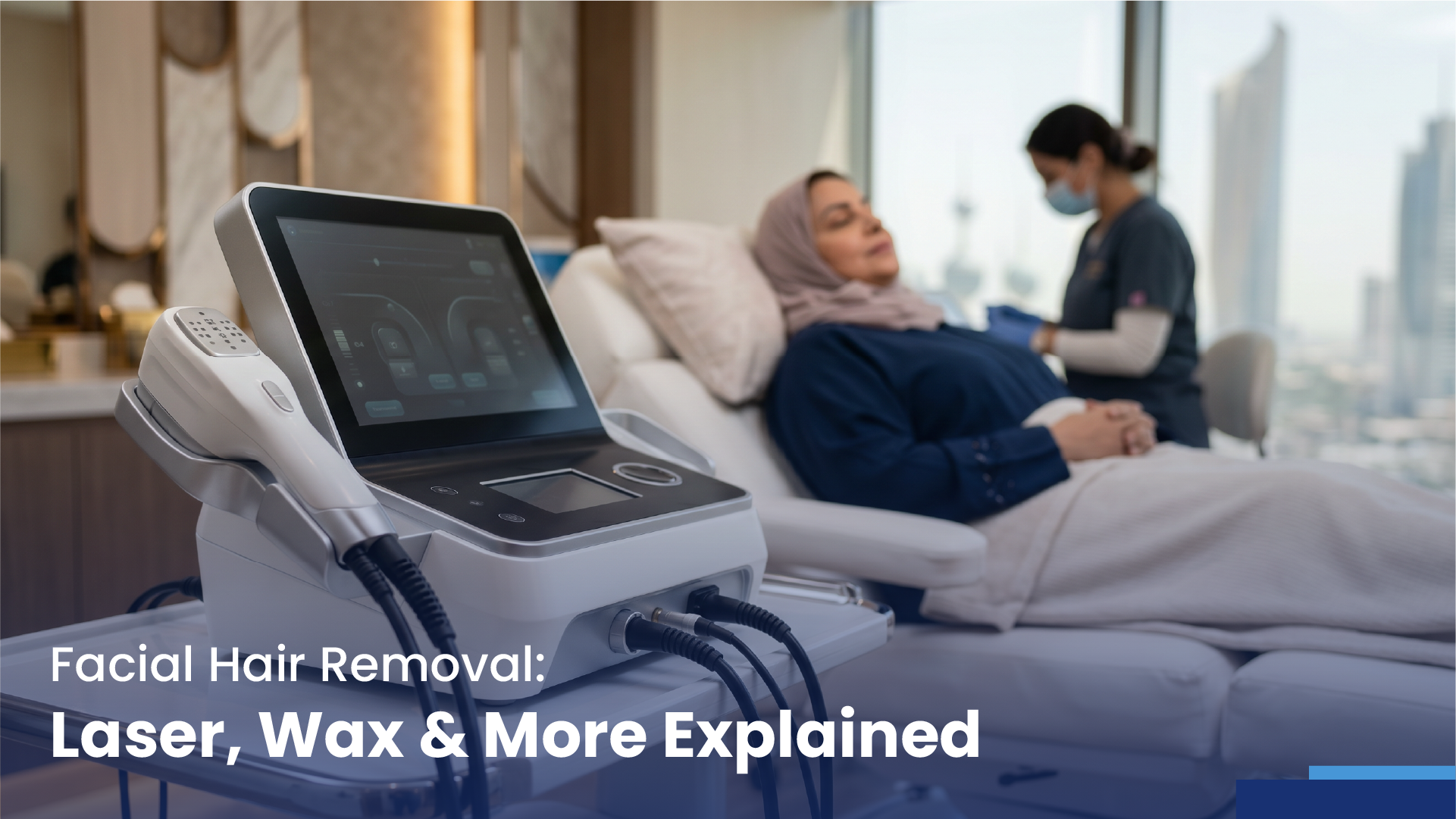
Facial hair removal is one of the most searched aesthetic topics for both women and men, and for good reason. The face is the most visible part of the body, and unwanted hair anywhere from the upper lip to the chin, cheeks, jawline, sideburns, or forehead hairline can be a persistent source of self-consciousness. At Blue Clinic, our dermatology and aesthetics department offers professional laser hair removal as the most effective long-term solution for unwanted facial hair, alongside expert guidance on which method best suits your skin type, hair type, and lifestyle.
In this guide we compare every major facial hair removal method — laser, IPL, threading, waxing, dermaplaning, electrolysis, and depilatory creams — covering how each works, how long results last, what it feels like, and what your skin type has to do with which option is most appropriate.
Why Facial Hair Removal Requires More Care Than Body Hair Removal
The skin on the face is thinner, more sensitive, and more exposed to daily factors including UV radiation, skincare products, and environmental pollutants than skin on the body. This means that some methods appropriate for the legs or arms require modification or are not advisable for facial use. Wax that is too hot, depilatory creams with high chemical concentrations, or aggressive physical exfoliation can cause reactions on facial skin that would not occur on body skin. Every method discussed in this guide is reviewed with specific attention to suitability for facial use.
Method 1: Laser Hair Removal
Laser hair removal is the gold standard for long-term reduction of unwanted facial hair. It uses concentrated light energy at a specific wavelength to target the melanin (pigment) in the hair follicle. The light energy is absorbed by the follicle and converted to heat, which damages the follicle’s ability to produce new hair. Hair in the active growth phase (anagen) is most effectively treated, which is why multiple sessions are required to capture all follicles as they cycle through growth phases.
Clinical outcome data, including meta-analyses published in the Journal of the American Academy of Dermatology, consistently report 70 to 90 percent long-term hair reduction after a complete course of laser hair removal.
Laser for Facial Hair: What to Expect
A consultation with a trained practitioner is the starting point. The laser wavelength, power settings, and spot size are calibrated based on your skin tone (Fitzpatrick scale classification), hair colour, hair thickness, and the specific facial area being treated. The Nd:YAG laser is the recommended wavelength for darker skin tones. The Alexandrite and diode lasers are highly effective for fair to olive skin tones.
Facial laser sessions are short — the upper lip can be treated in under five minutes, the full face in 20 to 30 minutes. Most patients describe the sensation as similar to a rubber band snap on the skin. Most facial areas require six to eight sessions spaced four to six weeks apart for the initial course. Our laser hair removal pricing guide covers what to expect from a full treatment course including session spacing and pricing for specific facial areas.
Laser for Men: Beard and Neck
Men increasingly seek laser hair removal for beard shaping, neckline definition, and reduction of ingrown hairs in the beard area caused by shaving. Beard and neck hair is typically coarser and denser than female facial hair, requiring adjusted treatment parameters and sometimes more sessions. Laser is particularly effective for men with a history of pseudofolliculitis barbae (razor bumps), where it reduces both the hair density and the chronic inflammation associated with the condition.
Who Is Not Suitable for Facial Laser?
Laser hair removal is not suitable for everyone. Grey, white, blonde, or very light red hair lacks sufficient melanin for the laser to target effectively. Active skin infections, open wounds, or active inflammatory skin conditions in the treatment area are contraindications. Patients on photosensitising medications should discuss this with their practitioner. Tanned skin from recent sun exposure increases the risk of side effects.
Method 2: IPL (Intense Pulsed Light)
IPL uses a broad-spectrum flash of light rather than a single laser wavelength. It works on the same principle as laser — targeting melanin in the hair follicle — but the broad spectrum makes it less precisely targeted than true laser. IPL is generally less effective than dedicated laser systems for hair removal, particularly for coarser hair and darker skin tones. It is appropriate for patients with fair to medium skin tones and dark hair. At-home IPL devices produce results consistently inferior to professional-grade clinic systems for facial areas where precision matters.
Method 3: Threading
Threading is an ancient hair removal technique that uses a twisted cotton thread to trap and pull hairs at the follicle level, removing multiple hairs in a single stroke. It is particularly well suited to eyebrow shaping and upper lip hair removal because of the precision it offers. Threading does not apply any heat or chemicals to the skin, making it a good option for patients with sensitive skin or conditions that preclude waxing.
Threading removes hair at the root but does not damage the follicle, so hair regrows at the same rate and texture. Results last approximately two to four weeks. Temporary redness and minor follicular bumps after treatment are common and typically resolve within a few hours.
Method 4: Waxing
Waxing applies a warm wax to the skin that adheres to the hairs and is removed quickly, pulling hairs out at the root. For facial use, hard wax is strongly preferred over soft strip wax, particularly for the upper lip and chin where skin is thinner and more delicate. Wax that is applied too hot or over skin using retinoids or acids can lift the top skin layer, causing skin damage. Patients using prescription retinoid creams or certain acne medications should not wax the affected areas. Results last two to four weeks.
Method 5: Dermaplaning
Dermaplaning uses a surgical-grade scalpel held at a 45-degree angle to the skin to shave off both vellus hair (peach fuzz) and the top layer of dead skin cells simultaneously. It is performed by trained practitioners. Dermaplaning leaves the skin feeling exceptionally smooth and improves the absorption of skincare products. It removes hair at the surface only and produces no change to the follicle, so regrowth occurs at the same rate and texture as before. The concern that dermaplaning makes hair grow back coarser is a myth. Results last three to four weeks. It is not appropriate for skin with active acne, rosacea flares, or open wounds.
Method 6: Electrolysis
Electrolysis is the only hair removal method that is classified as permanent by regulatory standards. A fine probe is inserted into each individual hair follicle and an electrical current is used to destroy the follicle’s ability to produce hair. Because each follicle must be treated individually, electrolysis is extremely time-consuming for large areas. For small facial areas such as a few scattered chin hairs or upper lip stragglers, it is an effective and permanent solution.
Electrolysis works on all hair colours including grey, white, and blonde — the hair colours that laser cannot effectively target. It is suitable for all skin tones. For patients who have had laser hair removal and have residual light-coloured hairs remaining, electrolysis is the appropriate follow-up for those specific follicles.
Method 7: Depilatory Creams
Depilatory creams use alkaline chemicals to break down the protein structure of the hair shaft, allowing the dissolved hair to be wiped away. Facial-specific products exist with lower chemical concentrations than body products. Using a body depilatory on the face risks chemical burns and irritation. Depilatory creams remove hair at the surface only, so results last one to three days before stubble is visible. They are not recommended for skin with active acne, eczema, or rosacea.
Comparing Facial Hair Removal Methods
- Laser: long-term reduction 70–90%, multiple sessions, professional only, best for dark hair on fair to dark skin, minimal downtime
- IPL: moderate long-term reduction, multiple sessions, less effective than laser, best for fair to olive skin with dark hair
- Threading: root removal, 2–4 week regrowth, best for eyebrows and upper lip, no chemicals or heat
- Waxing: root removal, 2–4 week regrowth, fast, caution with sensitive skin and medications
- Dermaplaning: surface only, 3–4 week regrowth, simultaneous exfoliation, not suitable for acne-prone skin
- Electrolysis: permanent, works on all hair colours, slow for large areas, ideal for isolated follicles or light-coloured hair
- Depilatory creams: surface only, 1–3 day regrowth, convenient but short-lived
Choosing the Right Method for Your Skin and Hair Type
Fair Skin with Dark Hair
This is the ideal combination for laser and IPL. High contrast between skin and hair melanin allows the device to target the follicle precisely with minimal risk to the surrounding skin. Laser hair removal will produce the most significant and lasting results.
Olive to Medium Skin Tones
Laser remains effective for olive skin tones with appropriate wavelength selection. The diode laser or Nd:YAG at calibrated settings is appropriate. Threading and waxing are suitable alternatives without skin-tone-related concerns.
Dark Skin Tones
Dark skin tones require an Nd:YAG laser (1064nm wavelength), which reduces the risk of skin darkening or blistering. Practitioners with specific experience treating darker skin tones are essential. IPL is generally not recommended for dark skin tones. Threading, waxing, and electrolysis are safe alternatives regardless of skin tone.
Light, Grey, or White Hair
Laser and IPL cannot effectively treat light, grey, or white hair because these hairs lack melanin for the device to target. Electrolysis is the only technology that works regardless of hair colour. Threading, waxing, and dermaplaning are mechanical methods effective for any hair colour.
Frequently Asked Questions
How many laser sessions does it take to remove facial hair?
Most facial areas require six to eight sessions spaced four to six weeks apart. Some areas with coarser hair may require additional sessions. A follow-up session after the initial course is usually recommended at three to twelve months to address any regrowth.
Is facial laser hair removal safe for dark skin?
Yes, when performed by a trained practitioner using an Nd:YAG laser with appropriate settings for dark skin. The dermatology team at Blue Clinic can advise on the most appropriate device and settings for your skin tone during a consultation.
Does waxing make facial hair grow back thicker?
No. Waxing removes hair at the root but does not alter the follicle structure. Hair grows back at the same rate and texture as before. The impression of thicker regrowth comes from the blunt tip of new growth, which feels more noticeable than the tapered tip of uncut hair.
Can I use a home IPL device on my face?
Home IPL devices are generally less powerful than professional systems and produce inferior results. For facial use, where precision and skin safety are particularly important, professional treatment is strongly recommended. Home IPL devices also require accurate self-assessment of your Fitzpatrick skin type, which is difficult without training.
How long before my wedding or event should I have laser hair removal?
For best results from laser hair removal, begin treatment at least six months in advance to complete a full course. For threading or waxing, a patch test should be done at least 48 hours before the event to check for any skin reaction.
Start Your Facial Hair Removal Journey
The most effective method for your specific situation depends on your skin tone, hair colour, facial area, lifestyle, and tolerance for ongoing maintenance versus a longer-term solution. For most patients seeking lasting results, laser hair removal remains the clear frontrunner.
Practical next steps:
- Visit our dermatology and aesthetics page to learn about laser hair removal services at Blue Clinic.
- Review our laser hair removal pricing guide for information on session costs and what a full course involves.
- Book a consultation through WhatsApp for a skin assessment and personalised treatment recommendation.
The Blue Clinic aesthetics team will assess your specific skin tone, hair type, and facial area to recommend the most effective and safest approach for you.