





Face lifting describes a range of procedures — surgical and non-surgical — that address the descent and laxity of facial tissues that occurs with ageing. At Blue Clinic Kuwait, face lifting is available through our dermatology and aesthetics department in both forms: surgical referral pathways for patients who need the full structural repositioning that only surgery can provide, and the Ultraformer HIFU system as our non-surgical face lifting treatment for patients seeking visible improvement without incisions or downtime.
This complete guide covers the science behind facial ageing, every available face lifting option from the most conservative to the most comprehensive, how to decide which approach suits your anatomy and goals, what results are realistic and over what timeline, and what questions to ask before you commit to anything.
Why the Face Ages the Way It Does
Understanding face lifting starts with understanding why the face changes with age. Three overlapping processes drive visible facial ageing. First, the skin thins and loses elasticity as collagen and elastin production declines. Second, the fat compartments of the face lose volume, causing hollowing in some areas. Third, and most relevant to face lifting, the structural ligaments that hold the facial soft tissue in place gradually weaken, allowing the tissue to descend under gravity. This produces the jowls along the jawline, the deepening of the nasolabial folds, the loss of neck definition, and the overall heaviness of the lower face that characterises the ageing face.
Different face lifting approaches address these three processes to different degrees. Non-surgical treatments primarily address the first. Surgical approaches can address all three simultaneously and most powerfully. Choosing the right intervention depends on which of these processes is most responsible for your current concerns and how advanced each has become.
Non-Surgical Face Lifting at Blue Clinic
Ultraformer HIFU: Our Primary Non-Surgical Lifting Treatment
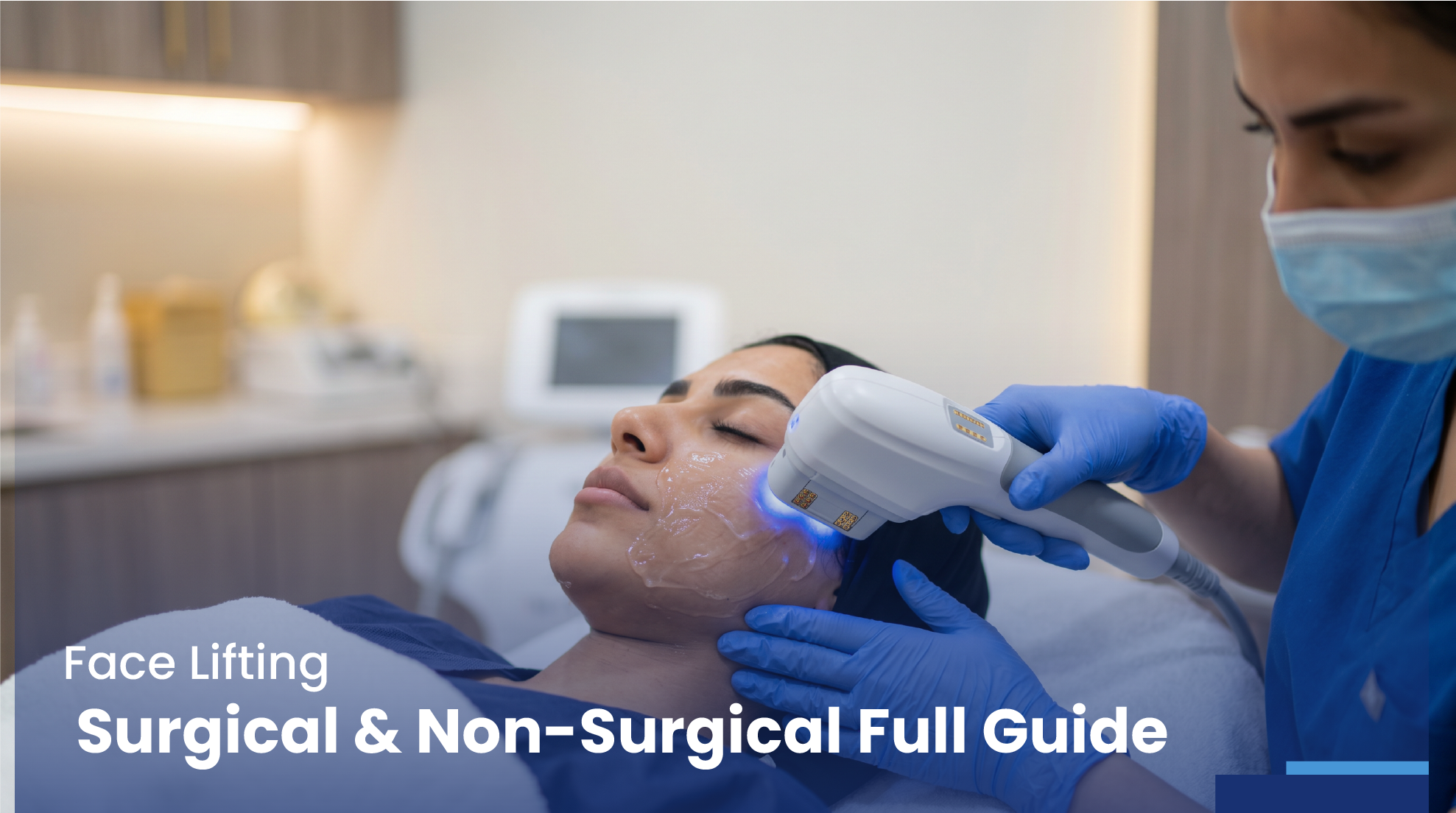
The Ultraformer system uses high-intensity focused ultrasound (HIFU) to deliver precise energy to the SMAS layer of the face and neck — the same deeper fibromuscular layer that surgeons address during a surgical facelift. The ultrasound energy heats this layer to the temperature required to stimulate collagen remodelling and new collagen formation without disrupting the surface of the skin.
Results from Ultraformer build gradually over two to three months as the biological collagen response progresses. Most patients see meaningful lifting and tightening of the lower face, jawline definition improvement, and neck tightening. The result typically lasts twelve to eighteen months before a maintenance session becomes appropriate. The treatment takes 45 to 90 minutes and requires no recovery period.
Ultraformer is appropriate for patients in their late thirties to mid-fifties with mild to moderate facial laxity who want a non-invasive improvement. The aesthetics team at Blue Clinic assesses each patient individually to confirm whether Ultraformer is the appropriate treatment or whether surgical referral would better serve their goals.
Thread Lifts
Thread lifts use dissolvable sutures with barbs or cones inserted under the skin to mechanically lift soft tissue while simultaneously triggering a collagen response around the threads. Results are immediate but partial, and the threads dissolve over six to twelve months. Thread lifts suit patients with early descent who want an immediate improvement with minimal recovery. They are not effective for significant laxity and produce subtler results than Ultraformer in most comparisons.
Radiofrequency (RF) Skin Tightening
Radiofrequency devices deliver controlled heat energy to the dermis to stimulate collagen production. They are effective for early skin laxity and skin quality improvement. RF devices are generally less effective than HIFU for deeper structural lifting because the energy does not penetrate to the SMAS level with the same precision. According to the American Society for Dermatologic Surgery, radiofrequency treatments have a well-established safety record for skin tightening applications.
Botox for Brow Lifting and Jawline Definition
Targeted botulinum toxin injections can produce lifting effects in specific areas. Injections into the muscles that pull the brow downward create an indirect brow lift. Injections along the lower jaw can improve masseter hypertrophy and contribute to a more defined jawline contour. These effects are subtle and temporary, lasting three to four months, but can be valuable as a complement to other treatments.
Dermal Fillers for Volume Restoration
Volume loss is one component of facial ageing. Fillers restore volume to hollowed cheeks, temples, and under-eye areas, which can give the face a lifted appearance even without directly lifting descended tissue. It is important to understand that fillers do not lift tissue — they replace lost volume. Fillers used appropriately as part of a structured treatment plan contribute meaningfully to facial rejuvenation.
Surgical Face Lifting: When and Why
Surgical face lifting is the definitive solution for significant facial tissue descent that non-surgical treatments cannot meaningfully address. Surgery physically repositions descended tissue and removes excess skin, producing a structural improvement that lasts years rather than months. The decision to proceed with surgical face lifting should follow a thorough consultation with a qualified facial plastic surgeon and an honest assessment of whether the goals can realistically be achieved by non-surgical means.
Mini Facelift
The mini facelift uses shorter incisions concentrated around the ear to address the lower face and early jowling. It involves less tissue mobilisation than a full facelift and has a shorter recovery of one to two weeks. It suits patients in their forties to early fifties with early to moderate descent and good skin elasticity. Results last five to seven years in most patients.
Full Facelift (SMAS Facelift)
The full facelift addresses the lower face and neck comprehensively. The SMAS layer is lifted and repositioned, excess skin is removed, and the neck platysma muscle can be tightened where indicated. Recovery involves two to four weeks of visible bruising and swelling. Results typically last seven to ten years.
Deep Plane Facelift
The deep plane facelift extends the dissection beneath the SMAS to release the structural retaining ligaments of the face, allowing a more complete and natural repositioning of facial fat and soft tissue. It is particularly effective for the nasolabial fold region and mid-face. The deep plane approach requires a surgeon with specific advanced training. Long-term outcome studies, including research published in the Plastic and Reconstructive Surgery journal, consistently show better durability with deep plane approaches compared to more superficial techniques.
Neck Lift
The neck lift addresses submental fat, platysmal banding, and skin laxity in the neck specifically. It can be performed as a standalone procedure or as part of a full facelift. Recovery is typically one to two weeks. A standalone neck lift does not address the lower face and should not be considered a substitute for a facelift when jowling is also present.
Who Is a Good Candidate?
For non-surgical Ultraformer treatment at Blue Clinic, ideal candidates are typically in their late thirties to early fifties, with mild to moderate facial and neck laxity, good skin quality, and specific concerns about jawline softening, early jowl formation, or neck laxity. Patients with very loose or redundant skin will not achieve meaningful improvement from Ultraformer alone.
For surgical facelift, ideal candidates are in stable health with no uncontrolled chronic conditions, non-smokers or willing to stop smoking well before and after surgery, with significant facial and neck laxity that cannot be adequately addressed by non-surgical means. Smokers face substantially elevated risks of wound healing complications. Most surgeons require smoking cessation for at least four to six weeks before and after surgery.
How to Choose Between Surgical and Non-Surgical
If the degree of descent and skin redundancy is mild to moderate, non-surgical options are worth pursuing first. They cost less, carry no surgical risk, require no recovery, and for the appropriate patient, produce genuine and visible improvement. If significant structural descent, jowling, neck banding, or skin redundancy is present, surgical lifting is the only treatment that will produce the desired result.
At Blue Clinic, our aesthetics team will tell you clearly if Ultraformer will meet your expectations or if your goals require a surgical referral. You can book a consultation through WhatsApp at any time.
Timeline of Results
Non-Surgical Ultraformer
Immediately after treatment: mild redness and occasional tenderness that resolves within hours to days with no downtime. Two to three months: the lifting effect becomes visible as collagen remodelling progresses. Six months: peak results. Twelve to eighteen months: results begin to fade and a maintenance session is appropriate.
Surgical Facelift
One to two weeks: visible bruising and swelling at peak, dressings removed. Two to three weeks: most patients comfortable returning to social settings. Six weeks: visible improvement clear, residual mild swelling. Three to six months: deeper swelling resolves. Twelve months: final settled result. Results last seven to ten years for full and deep plane procedures.
Aftercare and Maintaining Results
Non-surgical results from Ultraformer are best maintained with consistent sun protection, medical-grade skin care addressing collagen stimulation, and a maintenance Ultraformer session every twelve to eighteen months. Allowing the effects to fade completely before retreating requires starting the response cycle again from zero.
Surgical results are maintained primarily by protecting the skin from sun damage, not smoking, and maintaining a stable weight. Many patients choose a non-surgical maintenance programme with Ultraformer or fillers in the years following surgery to preserve their result.
Combining Face Lifting With Other Treatments
Face lifting, whether surgical or non-surgical, is often most effective as part of a coordinated treatment plan. Volume restoration with fillers addresses hollowing that lifting alone does not correct. Skin quality treatments including laser resurfacing and medical-grade skin care address surface texture and pigmentation. Brow treatments address the upper face, which face lifting does not significantly change.
At Blue Clinic, our aesthetics team can develop a coordinated plan that addresses facial ageing across all three processes. You can explore our full range of dermatology and aesthetics services and book a consultation through WhatsApp.
Frequently Asked Questions
Is non-surgical face lifting as effective as surgery?
No, not for patients with significant laxity. For patients with mild to moderate early laxity, non-surgical treatments including Ultraformer produce genuine and meaningful results. For patients with significant tissue descent, skin redundancy, or advanced jowling, surgery is the only approach that will achieve meaningful improvement.
How painful is the Ultraformer treatment?
Ultraformer produces a warm, tingly, and occasionally intense sensation during treatment. The level of discomfort varies between patients and by area. Topical anaesthetic cream can be applied before treatment to reduce discomfort. Most patients tolerate the treatment without significant difficulty.
How long does an Ultraformer session take?
A full face and neck treatment typically takes 60 to 90 minutes. Partial treatments targeting specific areas such as the lower face and jawline alone take approximately 30 to 45 minutes.
Can I have Ultraformer if I have had a surgical facelift previously?
Yes in most cases, with timing and treatment parameters adjusted appropriately. Ultraformer can be a useful maintenance tool after surgical face lifting, helping to preserve the result as further ageing continues. Inform your practitioner of any prior surgical procedures during your consultation.
How many Ultraformer sessions do I need?
Most patients achieve their best result from a single full-coverage session. A maintenance session every twelve to eighteen months is recommended to sustain the result. Some patients with more advanced laxity may benefit from two sessions spaced three to six months apart initially.
At what age should I start face lifting treatments?
Non-surgical preventive treatments can be started in the mid-thirties as a proactive measure. Surgical lifting is generally considered when descent is visible and meaningful and non-surgical options are no longer sufficient, typically from the mid-forties onward, though this varies significantly by individual.
Book Your Face Lifting Consultation at Blue Clinic
Face lifting is not a single decision but a spectrum of options that evolves with your anatomy and goals over time. Understanding where you sit on that spectrum is the starting point for making the right choice.
Practical next steps:
- Visit our dermatology and aesthetics page to learn about Ultraformer and other face lifting treatments available at Blue Clinic Kuwait.
- Book a consultation through WhatsApp for a clinical assessment that will tell you clearly whether Ultraformer or surgical referral better suits your current anatomy.
- Ask specifically: how much improvement can I realistically expect from non-surgical treatment with my current degree of laxity?
- If surgery is appropriate, ask for a referral with full written information about the procedure, recovery, and costs involved.
The team at Blue Clinic provides honest, expertise-led guidance on face lifting without pressure to choose the most expensive option.