







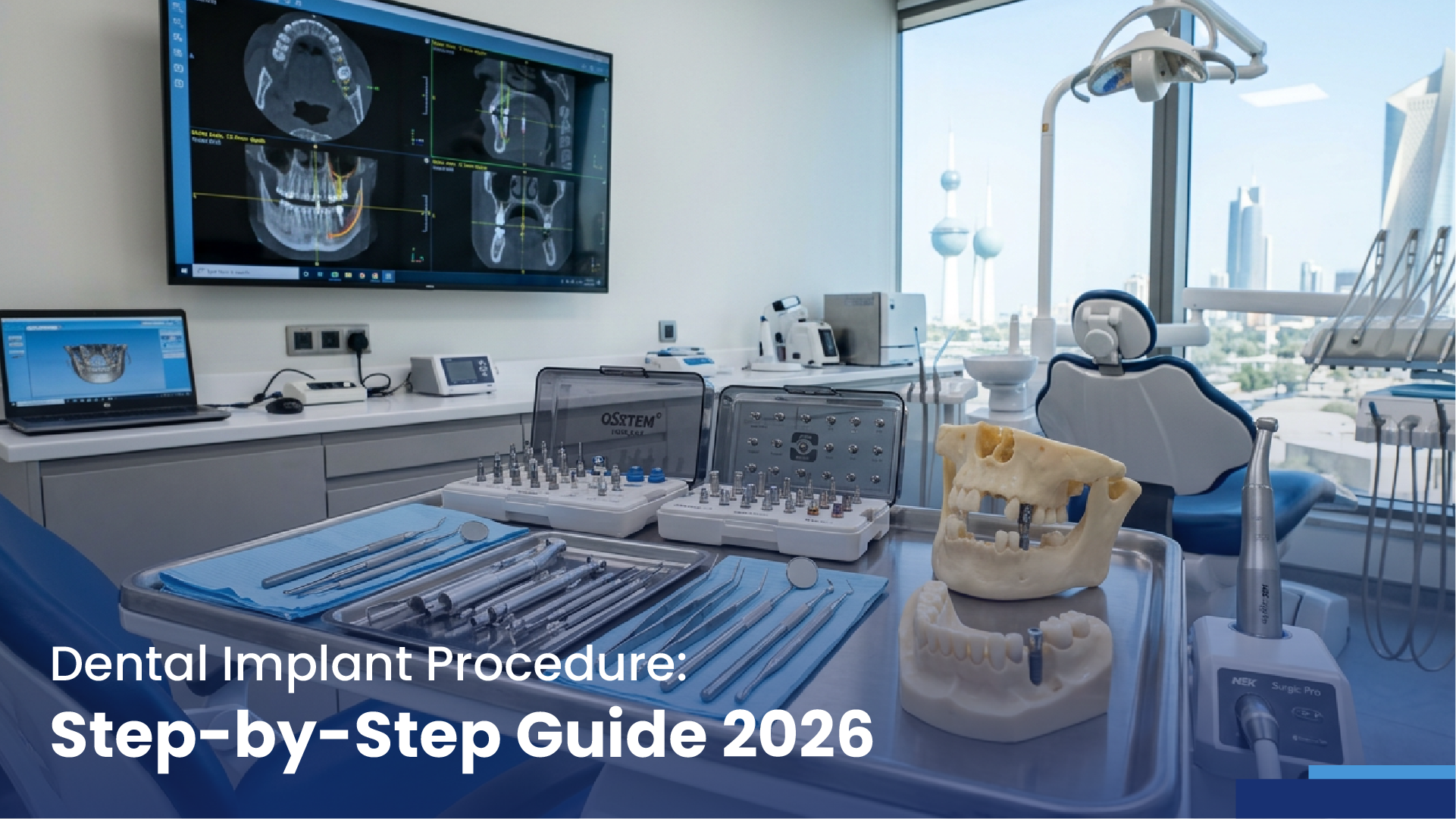
A dental implant procedure replaces a missing tooth from root to crown, restoring both function and appearance in a way that no other tooth replacement option currently matches. The process is more involved than fitting a bridge or denture, but the results are long-lasting when the right conditions are met. Understanding each stage before you start helps you prepare properly and set realistic expectations for the timeline. At Blue Clinic, the implant process begins with a thorough assessment to determine whether you are a suitable candidate before any treatment planning takes place.
In this guide, we will walk through every stage of the dental implant procedure in detail, including the initial assessment, the surgical phase, the healing period, and the placement of the final restoration. We will also cover costs, risks, aftercare, and how to know whether implants are the right choice for your situation.
What Is a Dental Implant?
A dental implant is a small titanium post that is surgically inserted into the jawbone to act as an artificial tooth root. Over several months, the implant fuses with the surrounding bone through a biological process called osseointegration. Once that bond is established, a connector piece called an abutment is attached to the implant, and a custom-made crown is placed on top to form the visible artificial tooth.
The result is a replacement tooth that looks, feels, and functions like a natural one. The implant stimulates the jawbone the way a natural root does, preventing the bone loss that occurs after tooth extraction. Our dental implants page provides a full overview of what treatment at Blue Clinic involves, including candidacy requirements and available implant systems.
Who Is a Candidate for Dental Implants?
Not everyone is automatically suitable for implants. The procedure requires adequate bone volume and density to anchor the implant securely, healthy gum tissue, and good general health. Patients with uncontrolled diabetes, those taking certain bone medications, heavy smokers, and those who have received high-dose radiation to the jaw area may face higher complication risks or may require additional assessment before proceeding.
Age is also a factor. Implants are generally not placed in patients whose jawbones have not yet finished developing, which typically means waiting until the late teens or early twenties depending on the individual. A cone-beam CT scan (CBCT) is usually required to evaluate bone volume in three dimensions before a treatment plan is finalised. If insufficient bone is present, bone grafting may be recommended as a preparatory step. The periodontics team at Blue Clinic assesses each case individually and will advise honestly whether implants are the right path or whether alternatives should be considered.
The Dental Implant Procedure: Step by Step
Step 1: Initial Consultation and Assessment
The process starts with a comprehensive clinical examination. The dentist reviews your dental and medical history, examines the gum tissue and remaining teeth, and takes the necessary imaging. A CBCT scan provides a three-dimensional view of the bone structure, nerve positions, and sinus anatomy, which is essential for precise surgical planning. According to guidance from the International Team for Implantology, thorough pre-surgical assessment is the single most important factor in achieving predictable implant outcomes.
At this stage, any existing dental problems are identified. Active gum disease, untreated decay, or a bite issue that places excessive force on specific teeth may need to be addressed before implant placement. This phase ends with a personalised treatment plan that outlines the number of implants required, whether preparatory procedures are needed, and a realistic timeline for the full treatment. You can book a consultation at Blue Clinic through WhatsApp.
Step 2: Preparatory Procedures (If Required)
Some patients require preparatory work before the implant can be placed. The most common preparatory procedures are tooth extraction, bone grafting, and sinus lifting.
If the tooth to be replaced is still present and in poor condition, it will need to be removed first. Our page on tooth extraction in Kuwait covers what that procedure involves and what to expect during recovery. Depending on the condition of the extraction site, the implant may be placed immediately after extraction or after a healing period of several weeks.
Bone grafting is used when the available bone is too thin or too shallow to support an implant reliably. Grafting material, which may be synthetic, donor-derived, or taken from another site in the patient’s mouth, is placed at the site and given time to integrate with the existing bone. This can add three to six months to the overall timeline. A sinus lift is a specific type of bone graft used in the upper jaw when the sinus cavity sits too close to the proposed implant site.
Step 3: Implant Placement Surgery
Implant placement is performed under local anaesthesia and is typically a straightforward outpatient procedure. Sedation options are available for patients who experience significant dental anxiety. The procedure itself usually takes between 30 minutes and two hours depending on the number of implants being placed and the complexity of the case.
The dentist makes a small incision in the gum tissue to expose the bone, then uses precision drills to create a channel of the exact diameter and depth required for the chosen implant. The titanium implant is then inserted into this channel and the gum tissue is sutured closed. In some cases a healing cap is placed on top of the implant to maintain the shape of the gum tissue during osseointegration. The types of dental implants available differ in diameter, length, and connection design, and the selection is made based on the specific anatomy and load requirements of each case.
After surgery, mild swelling, bruising, and discomfort are normal and typically resolve within a week. Cold compresses, prescribed pain medication, and a soft diet during the initial days after surgery help manage the recovery period effectively.
Step 4: Osseointegration
Osseointegration is the biological process by which the titanium implant fuses with the surrounding jawbone. This is the foundation of the entire procedure and the reason why dental implants can function so similarly to natural teeth. It cannot be rushed. The healing period typically ranges from six weeks to six months depending on the patient’s bone density, the implant location, whether bone grafting was involved, and general health factors.
During this period the implant is left undisturbed while the bone grows into the microscopic surface texture of the titanium. Clinical research published by the Journal of Dental Research consistently confirms that osseointegration success rates above 95 percent are achievable in appropriately selected cases when the surgical technique and postoperative care protocols are followed correctly. Smoking significantly reduces osseointegration quality and is one of the strongest predictors of implant failure.
Step 5: Abutment Placement
Once the implant has integrated successfully, a second minor procedure is carried out to place the abutment. This is the small connector component that links the implant to the final crown. In some implant systems the abutment is placed at the same time as the implant during the initial surgery. In two-stage systems a small incision is made to expose the implant and the abutment is attached.
The gum tissue around the abutment is given two to four weeks to heal and shape itself before impressions or digital scans are taken for the final crown. During this period a temporary crown is sometimes placed to maintain the appearance of the smile and protect the site. The prosthodontics team at Blue Clinic handles the crown design and fitting phase.
Step 6: Crown Placement
The final stage is the placement of the permanent crown. Impressions or digital scans taken from the abutment are sent to a dental laboratory where a custom crown is fabricated to match the shape, size, and shade of the surrounding teeth. This stage typically takes one to two weeks.
At the fitting appointment, the crown is trial-seated to verify the bite, aesthetics, and marginal fit before being permanently cemented or screwed into place. Once fitted, the implant-supported crown functions like a natural tooth. The full process from initial consultation to final crown placement is covered in detail in our guide on implant treatment stages.
How Long Does the Full Procedure Take?
The total timeline from first consultation to final crown depends heavily on individual circumstances. In straightforward cases without the need for preparatory procedures, the process from implant placement to crown delivery can take as little as three to four months. In cases requiring bone grafting or sinus lifts, the timeline extends to nine to eighteen months.
This is one of the most significant differences between implants and alternatives such as dental bridges. A dental bridge can typically be completed in two to three weeks. Patients who need a tooth replacement quickly may need to consider a bridge or temporary option first while planning for a longer-term implant solution.
Dental Implant Costs: What to Expect
The cost of a dental implant varies depending on the number of implants, the crown material, whether preparatory procedures are needed, and the clinic. In Kuwait, private implant costs vary between clinics, and the quoted price should be clarified to understand exactly what is included, such as the implant, the abutment, the crown, and the surgical fees.
Preparatory procedures including bone grafting, sinus lifts, or extractions carry additional costs that should be factored into the total. Patients who need implants in multiple sites will find the cost increases proportionally, though some combined treatment plans offer more economical pricing per unit. Our dedicated pricing guide on dental implant cost in Kuwait provides a detailed breakdown of the factors that influence the total investment.
Risks and Potential Complications
Dental implants are among the most thoroughly studied procedures in dentistry, and their long-term success rates are well documented. However, as with any surgical procedure, risks exist. The most common include infection at the surgical site, implant failure due to poor osseointegration, nerve sensitivity in the lower jaw if placement is too close to the inferior alveolar nerve, and sinus complications in the upper jaw.
Long-term, the most significant risk is peri-implantitis, which is an inflammatory condition affecting the tissues surrounding an established implant. It is the implant equivalent of gum disease and is driven by bacterial accumulation around the implant neck. Proper oral hygiene and regular professional maintenance significantly reduce the risk. The periodontics department monitors implant health as part of long-term follow-up care.
Aftercare and Long-Term Maintenance
A successful implant procedure requires ongoing maintenance. The titanium implant itself is not susceptible to decay, but the surrounding gum tissue and bone can still develop disease if hygiene is neglected. Brushing twice daily, using interdental brushes or water flossers around the implant, and attending professional cleaning appointments every six months are the cornerstones of long-term implant health.
The crown placed on the implant, while highly durable, is not indestructible. Patients who grind their teeth at night should discuss a night guard with their dentist to protect the crown from excessive wear. With proper care, a well-placed implant can last for decades. The dental care team at Blue Clinic provides ongoing monitoring as part of every implant patient’s aftercare protocol.
Implants vs Bridges: Which Is Right for You?
Dental implants and bridges are both established options for replacing missing teeth, but they suit different circumstances. Implants preserve jawbone, do not require modification of adjacent teeth, and offer better long-term durability in most cases. Bridges are faster, less invasive, and more affordable, making them a practical choice when adjacent teeth already need crowns or when time and budget are primary constraints.
The right choice depends on bone availability, the health of adjacent teeth, the patient’s overall health, the timeline, and budget. Neither option is universally superior. A consultation with the dental team at Blue Clinic is the starting point for making a well-informed decision.
Frequently Asked Questions
Is the dental implant procedure painful?
The procedure is performed under local anaesthesia, so there should be no pain during surgery. Post-operative discomfort, mild swelling, and bruising are expected for the first few days and are managed with prescribed or over-the-counter pain relief. Most patients report that the recovery was more straightforward than they anticipated.
Can I eat normally after implant surgery?
A soft diet is recommended for the first one to two weeks after surgery. Hard, crunchy, and very hot or cold foods should be avoided while the surgical site heals. Once osseointegration is complete and the final crown is fitted, the implant can handle normal chewing forces.
How do I know if my implant has failed?
Signs of implant failure include persistent pain or discomfort at the site, movement of the implant, swelling that does not resolve, or a feeling that the crown is shifting. These symptoms should prompt immediate contact with your dentist. Early intervention often allows the problem to be managed before it progresses.
Are dental implants suitable for older patients?
Age alone is not a contraindication for dental implants. Older adults in good general health with adequate bone volume can achieve excellent results. The key factors are bone quality, gum health, and the absence of uncontrolled systemic conditions rather than age itself.
How long does the implant last?
The titanium implant post can last a lifetime when properly maintained. The crown placed on top typically has a lifespan of 15 to 25 years depending on the material and care. Regular check-ups allow any wear to be identified and addressed before it becomes a problem.
Can implants be done for multiple missing teeth?
Yes. Multiple implants can be placed to support individual crowns for each missing tooth, or a smaller number of implants can be used to anchor a bridge or full-arch restoration. The treatment plan for multiple missing teeth depends on the bone available, the spacing, and the patient’s goals and budget.
Planning Your Implant Treatment
A dental implant is a significant decision that benefits from careful planning and honest professional guidance. The procedure is well-established, highly effective, and capable of restoring full function and appearance. Understanding the timeline, the stages involved, and the aftercare requirements puts you in the best position to move forward with confidence.
Practical next steps:
- Visit our dental implants page to review candidacy requirements and treatment details at Blue Clinic.
- Book a consultation through WhatsApp to have your case assessed with imaging and a personalised treatment plan.
- Ask specifically about whether preparatory procedures are needed and how they would affect your timeline and total cost.
- Discuss the long-term maintenance protocol and what regular follow-up involves after the final crown is placed.
The implant and periodontics team at Blue Clinic is available to guide you through every stage. Reach out to arrange your assessment.