

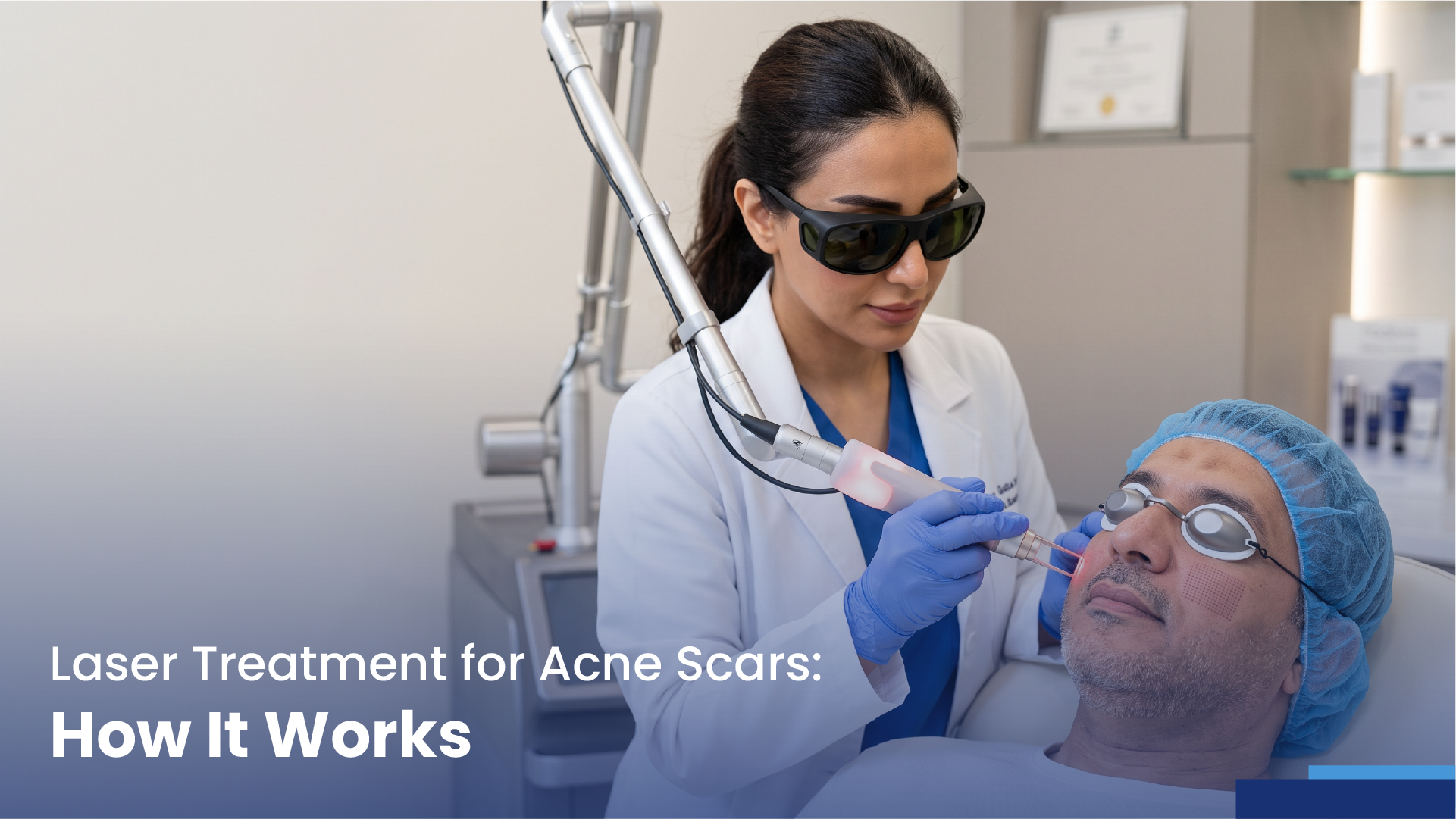
Laser treatment is one of the most powerful tools available for improving acne scars, but it is also one of the most misunderstood. The term covers a diverse range of devices with genuinely different mechanisms, different downtimes, different levels of effectiveness for different scar types, and different safety profiles across skin tones. Understanding what laser treatment actually does, which type suits your scars, and what to realistically expect from a course of sessions makes the difference between choosing a treatment that delivers meaningful improvement and investing in one that falls short. At Blue Clinic‘s dermatology and aesthetics department, laser treatment for acne scars is selected based on a thorough assessment of the scar types, the patient’s skin tone, and their downtime tolerance.
This guide explains the mechanism behind laser resurfacing, the main types of lasers used for acne scars, which scar types respond best, the number of sessions typically needed, the downtime involved, and what improvement is realistically achievable.
How Laser Resurfacing Works
Laser treatment for acne scars works through two complementary mechanisms. The first is removing or ablating the outer damaged skin layers, allowing fresh, healthier skin to grow in their place. The second, and more important, is stimulating the deeper dermal layer to produce new collagen. Collagen is the structural protein that fills in the depressions created by atrophic scars from below, gradually raising the scar floor toward the level of the surrounding skin. The scar does not disappear in one session; it improves progressively as new collagen matures over months following each treatment.
The fundamental division in laser types is between ablative and non-ablative:
- Ablative lasers physically remove the outer layer of skin. More powerful and typically faster-acting, but with more significant downtime and higher risk of side effects in darker skin tones.
- Non-ablative lasers heat the dermis to stimulate collagen without removing the skin surface. Gentler, less downtime, but slower improvement and typically more sessions required.
Most modern laser treatment uses a fractional approach, where the laser beam is split into thousands of microscopic columns that treat only a fraction of the skin surface at each pass. The untreated skin between the columns heals much faster than if the whole surface were treated, reducing downtime significantly while preserving effectiveness.
Fractional CO2 Laser
Fractional carbon dioxide laser is the most powerful and most studied resurfacing laser for acne scars. It is an ablative fractional laser, meaning it vaporises tiny columns of skin tissue to a precise depth while leaving the surrounding skin intact to accelerate healing.
CO2 laser creates the deepest collagen remodelling response of any laser modality and produces the most significant improvement in a single session. It is most effective for boxcar and rolling scars and for improving overall skin texture. Because it is ablative, it causes predictable redness and the treated skin sheds over the following week, requiring a social downtime of approximately one to two weeks. The new skin that emerges is initially pink, gradually settling over several weeks to months.
The skin tone consideration is important. CO2 laser carries a higher risk of post-inflammatory hyperpigmentation in medium and dark skin tones (Fitzpatrick III-VI). For these patients, the laser parameters must be carefully adjusted, a conservative approach is essential, and diligent pre- and post-treatment skincare with pigment-suppressing agents is required. An experienced provider working with darker skin minimises this risk significantly.
Fractional Erbium Laser (Er:YAG)
Erbium laser is an ablative laser that targets water in the skin tissue, but with greater precision and less heat dispersion into the surrounding dermis than CO2 laser. This means it ablates effectively while causing less collateral thermal damage, which translates to a shorter healing time, less post-treatment redness, and a lower risk of pigmentation changes.
Erbium laser is particularly well suited to shallower acne scars and to patients with medium to darker skin tones where the reduced heat is an advantage. It tends to require more sessions than CO2 laser to achieve equivalent improvement, but each session is better tolerated and the risk profile is more favourable. It is often the preferred ablative choice for patients who cannot afford the downtime of CO2 laser or who have skin tones where CO2 carries greater risk.
Fractional Non-Ablative Lasers
Non-ablative fractional lasers (commonly at wavelengths of 1540nm, 1550nm, or 1927nm) heat the dermis to stimulate collagen without removing the skin surface. Because the surface remains intact, the downtime is dramatically reduced — most patients experience redness and mild swelling for one to three days rather than a week or more. Normal social activities can typically resume within a day or two.
The trade-off is effectiveness per session. Non-ablative lasers produce a more gradual improvement and typically require more sessions (four to six or more) to achieve results comparable to ablative approaches. However, for patients with mild to moderate scarring, for those with schedule constraints that make longer downtime impractical, or for those with medium to darker skin where ablative approaches carry higher risk, non-ablative fractional laser is a well-evidenced and clinically appropriate choice. According to a systematic review in the Aesthetic Surgery Journal, fractional laser modalities consistently demonstrate meaningful scar improvement, with ablative approaches producing higher improvement per session and non-ablative approaches providing a better safety profile for repeated use across diverse skin tones.
Which Scar Types Respond Best to Laser
Not all acne scars respond equally well to laser treatment:
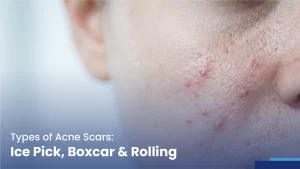
- Boxcar scars (shallow): excellent response to fractional laser, both ablative and non-ablative. The walls of the scar fill in progressively with new collagen.
- Boxcar scars (deep): benefit from laser as part of a combination approach, often preceded by subcision to release the scar base first.
- Rolling scars: respond well to laser for surface texture improvement, but the tethering mechanism underneath is best addressed first with subcision. Laser after subcision produces significantly better results than laser alone.
- Ice pick scars: laser alone is insufficient. These deep, narrow scars are best treated with TCA CROSS or punch excision, and laser can then improve the residual surface change. Using laser as the sole treatment for ice pick scars is a common and disappointing mistake.
- Hypertrophic scars: vascular lasers can reduce redness and flatten raised scars as part of a treatment plan alongside corticosteroid injections.
- Post-inflammatory hyperpigmentation: lasers designed to target pigment can accelerate fading, but topical treatment and sun protection are more reliable and carry less risk of worsening the pigment.
How Many Sessions Are Needed?
- Fractional CO2 laser: often one to three sessions spaced three to four months apart. Each session produces significant improvement, and many patients see substantial change after the first session.
- Erbium laser: typically two to four sessions spaced four to eight weeks apart.
- Non-ablative fractional laser: four to six sessions or more, spaced four to six weeks apart. Improvement is cumulative across the course.
Improvement continues for three to six months after each session as the collagen that was stimulated during treatment matures. This means assessment of results should happen several months after the final session, not immediately afterward.
What to Expect During Recovery
Ablative laser (CO2 and Erbium)
Immediately after treatment, the skin is red and feels like a sunburn. The treated columns of skin gradually shed over four to seven days as the new skin grows from below. Social downtime is typically five to ten days for CO2 laser and three to seven days for Erbium, meaning most people would not want to be in a professional or social setting during this period. The post-treatment redness gradually fades over four to eight weeks. Strict sun avoidance and gentle skincare are essential during healing.
Non-ablative fractional laser
Redness and mild swelling peak in the first few hours and typically resolve within one to three days. There is no surface shedding. Most patients can return to work or social activities the following day with appropriate skincare and sun protection. Makeup can generally be applied once any surface reaction settles.
Who Is a Good Candidate for Laser Treatment?
Ideal candidates for acne scar laser treatment are:
- Adults with stable, non-active acne scarring. Active breakouts must be controlled before laser treatment begins.
- Patients with realistic expectations — understanding that meaningful improvement (30-70 percent) is the realistic goal rather than complete elimination.
- Fair to medium skin tones: the safest candidates for ablative laser. Medium to darker tones can be treated but require careful device selection, conservative parameters, and pre- and post-treatment care.
- Patients willing to commit to strict sun protection before and after treatment.
Laser treatment is not appropriate during active acne outbreaks, in patients currently taking isotretinoin (a washout period is required), in patients with certain skin conditions affecting the treatment area, or in pregnancy. Darker skin tones can benefit from laser but require an experienced provider comfortable with adjusting parameters for their skin type. This is specifically where choosing a qualified dermatology provider rather than a non-medical laser centre makes a significant safety difference.
Combining Laser with Other Treatments
The best outcomes for acne scar treatment almost always come from combination approaches rather than laser alone:
- Subcision then laser: subcision releases the fibrous bands causing tethering in rolling and deep boxcar scars; laser then improves the surface texture. This two-step approach produces substantially better results than either alone.
- TCA CROSS then laser: TCA CROSS targets ice pick scars; laser improves the broader surface texture and any boxcar or rolling scars simultaneously present.
- PRP with laser: injecting or applying the patient’s own platelet-rich plasma immediately after laser treatment enhances the healing response and collagen stimulation.
- Topical retinoids between sessions: maintain collagen remodelling activity between laser sessions and improve overall skin quality.
The Blue Clinic team develops combination protocols based on the scar types present, the patient’s skin tone, and their downtime tolerance, ensuring the treatment plan is tailored rather than generic.
Frequently Asked Questions
Is laser treatment for acne scars permanent?
The collagen that forms in response to laser treatment is permanent structural change. The skin does not return to its pre-treatment state. However, the natural ageing process continues and new acne can create new scarring, which is why controlling acne before and after scar treatment matters. The improvements made are lasting.
Does laser treatment hurt?
Ablative laser treatments are performed with topical numbing cream applied 45-60 minutes before the session. During the treatment there is a sensation of heat or pricking. Most patients describe it as uncomfortable but manageable with the numbing. Non-ablative laser produces milder sensations. The treated skin feels warm and sensitive for hours after the session.
Can I have laser treatment on dark skin?
Yes, but it requires careful consideration of device choice and parameters. Darker skin tones (Fitzpatrick IV-VI) carry a higher risk of post-inflammatory hyperpigmentation from ablative lasers because the heat stimulates melanocytes. Non-ablative fractional lasers and erbium laser at conservative settings are generally safer for darker skin. The critical factor is the experience and expertise of the provider.
How soon after stopping isotretinoin can I have laser treatment?
The standard recommendation is to wait six months to a year after stopping isotretinoin before undergoing ablative laser treatment. Isotretinoin affects skin healing and increases the risk of abnormal healing from aggressive skin treatments. Non-ablative approaches may be considered sooner at the discretion of the dermatologist.
What is the realistic improvement I can expect?
Most studies and clinical experience report 30-70 percent improvement in the appearance of acne scars with a course of appropriate laser treatment. Some patients see greater improvement, particularly with shallow boxcar or rolling scars. Ice pick scars generally show less dramatic improvement with laser alone. Complete elimination of scars is rarely achieved. The goal is clinically meaningful, visible improvement that makes the scars significantly less noticeable in everyday life.
Getting Started with Laser Scar Treatment
Laser treatment for acne scars works best when the right device is selected for the scar type, the patient’s skin tone is respected in the choice of parameters, realistic expectations are set, and the treatment is combined with other modalities where appropriate.
- Visit the Blue Clinic dermatology department for a full acne scar assessment and laser consultation, including scar type classification and device selection.
- Book through WhatsApp to discuss your scars, skin tone, and goals with a qualified dermatologist.
The team at Blue Clinic provides fractional laser treatment for acne scars as part of a comprehensive scar management programme that includes combination treatments tailored to each patient’s individual presentation.