

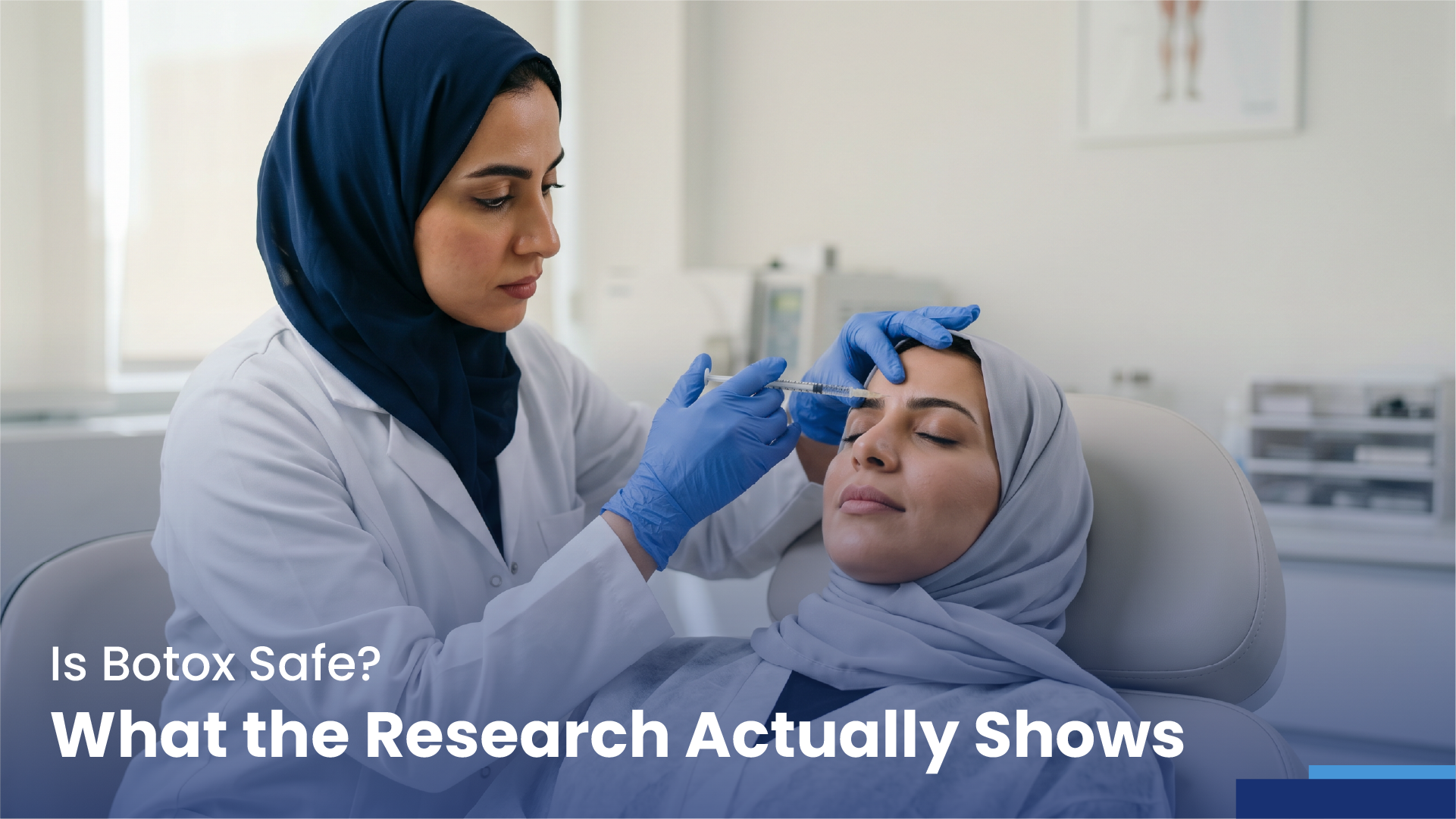
Botox safety is one of the most searched questions in aesthetic medicine, and it deserves a clear, evidence-based answer rather than a promotional one. The short answer is: yes, botulinum toxin type A administered by a qualified, licensed medical professional using approved products is one of the most extensively studied cosmetic treatments available, with a long-term safety record that few other procedures can match. At Blue Clinic, Botox treatments are performed exclusively by qualified medical professionals through our dermatology and aesthetics department.
This article covers what Botox actually is, what the research shows about its safety over more than two decades of clinical use, what side effects are possible and how common they are, who should avoid it, and what questions to ask before proceeding.
What Is Botox?
Botox is the brand name for a purified formulation of botulinum toxin type A, a protein produced by the bacterium Clostridium botulinum. In cosmetic applications, it is injected in extremely small quantities into specific facial muscles to temporarily relax them, reducing the appearance of dynamic wrinkles — the lines formed by repetitive facial expressions such as frowning, squinting, and smiling.
Botulinum toxin works by blocking the release of acetylcholine at the neuromuscular junction — the point where nerve signals meet muscle fibres. Without acetylcholine, the muscle cannot contract. The effect is temporary because the nerve eventually forms new junctions, restoring muscle function. This is why Botox results last three to six months and repeat treatment is required.
The FDA Approval History
Botulinum toxin was not developed as a cosmetic product. It was first approved by the US Food and Drug Administration in 1989 for the treatment of strabismus (crossed eyes) and blepharospasm (uncontrolled eye blinking) — genuine medical conditions requiring precise muscle control. In 2002, the FDA approved botulinum toxin type A (Botox Cosmetic) for the cosmetic treatment of glabellar lines (frown lines between the eyebrows) in adults. Since then, FDA approval has been extended to include crow’s feet, forehead lines, and multiple other medical indications including chronic migraine, hyperhidrosis, overactive bladder, and cervical dystonia.
This medical history is relevant to the safety question because it means the molecule has decades of clinical data from both therapeutic and cosmetic use populations. According to the American Society of Plastic Surgeons, botulinum toxin injections are the most performed non-surgical cosmetic procedure in the United States every year.
What the Safety Data Actually Shows
The safety profile of Botox in cosmetic doses is well-established. Adverse events from properly administered cosmetic Botox are predominantly mild and temporary. Large-scale clinical data, including reviews published in the Journal of the American Academy of Dermatology, consistently report:
- Injection site bruising and redness: the most common adverse event, occurring in a small percentage of patients, resolving within days.
- Temporary headache: reported in a minority of first-time patients, typically resolving within 24-48 hours.
- Eyelid or brow ptosis (drooping): occurs in less than 1% of cases when injections are placed in proximity to the levator palpebrae muscle. It is temporary, resolving as the effect wears off, and is associated primarily with improper injection technique.
- Asymmetry: occasionally requiring a touch-up dose, more common in patients with pre-existing facial asymmetry.
Serious adverse events from cosmetic Botox are extremely rare when treatment is performed by qualified practitioners using approved pharmaceutical products at appropriate doses.
The Risk That Actually Matters: Who Delivers It
The most important safety variable in Botox treatment is not the molecule — it is the person administering it. The risks of cosmetic Botox administered by an unqualified provider, using non-pharmaceutical-grade product (counterfeit or compounded toxin), or at incorrect dosage and depth are substantially higher. Unlicensed providers, non-medical settings, and suspiciously low pricing are reliable red flags.
Counterfeit botulinum toxin products have been associated with serious adverse events including systemic botulism in documented cases reported to the US Centers for Disease Control. These events are not attributable to the drug itself but to the source and setting of administration. Receiving treatment from a licensed medical professional using pharmacy-grade product in a clinical setting eliminates this risk category entirely.
Long-Term Safety: What Decades of Use Show
Botox has been used clinically for over 35 years. The question of long-term safety — particularly whether repeated cosmetic use over many years causes lasting muscle atrophy or other changes — has been studied extensively. The current evidence indicates:
- Repeated cosmetic use does not cause permanent muscle damage in the doses used for aesthetic purposes.
- Some long-term users show reduced muscle bulk in treated areas due to disuse, but this is reversible if treatment is discontinued.
- No systemic accumulation of the toxin has been demonstrated with cosmetic dosing.
- No increased cancer risk, organ damage, or neurological effects have been identified in long-term cosmetic users.
A 2021 review published in the Aesthetic Surgery Journal concluded that long-term repeated cosmetic botulinum toxin use is not associated with any identified serious safety concerns when performed with pharmaceutical-grade products by trained practitioners.
Who Should Not Have Botox?
Botox is contraindicated in certain patient groups:
- Pregnancy and breastfeeding: insufficient safety data exists for fetal and infant exposure; standard practice is to defer treatment.
- Neuromuscular disorders such as myasthenia gravis or Lambert-Eaton syndrome: botulinum toxin could exacerbate these conditions.
- Allergy to botulinum toxin or any components of the formulation.
- Infection or inflammation at the proposed injection site: treatment should be deferred until resolved.
- Patients taking aminoglycoside antibiotics: these drugs enhance the effect of botulinum toxin.
Age is a consideration: most practitioners do not offer cosmetic Botox to patients under 18. There is no upper age limit, though the clinical context changes for older patients.
Setting Realistic Expectations About Results
Safety and efficacy are related but different questions. Botox is safe when properly administered, but the quality of the result depends on the injector’s anatomical knowledge, aesthetic judgment, and technical skill. The goal is natural-looking relaxation of dynamic wrinkles — not a frozen or expressionless appearance. Over-treatment or poorly placed injections can produce aesthetically undesirable results even when medically safe.
Discussing your goals honestly with the treating practitioner before injection is the most effective way to ensure the outcome matches your expectations. The Blue Clinic aesthetics team takes a conservative, anatomy-led approach that prioritises natural results.
Frequently Asked Questions
Is Botox the same as dermal fillers?
No. Botox is a muscle relaxant that addresses dynamic wrinkles — lines caused by movement. Dermal fillers are volume-adding products (typically hyaluronic acid) that address static wrinkles, hollowing, and structural loss. They work differently, are placed differently, and are used for different indications, though they are often combined in a treatment plan.
Does Botox hurt?
The needles used for Botox injection are very fine and the injections are brief. Most patients describe the sensation as a small pinch. Topical numbing cream can be applied before treatment if the patient is particularly sensitive. Ice applied immediately before injection also reduces sensation.
Can Botox be reversed?
Botox cannot be chemically reversed as dermal fillers can. The effect wears off naturally over three to six months as the nerve-muscle connection re-establishes. Ptosis from inadvertent spread to the wrong muscle can sometimes be managed with prescription eye drops that stimulate a different muscle, but the most reliable resolution is time.
How do I know if a clinic is using genuine Botox?
Ask the clinic to specify the product they use (Botox by Allergan, Dysport by Ipsen, Xeomin by Merz are the main approved brands). Reputable clinics can show evidence that they source pharmaceutical-grade products from licensed distributors. Prices significantly below the typical market range are a warning sign that the product may not be what it appears.
Getting Started Safely
- Visit our dermatology and aesthetics department page to learn about Botox and injectable treatments at Blue Clinic.
- Book a consultation through WhatsApp to discuss your goals, have your facial anatomy assessed, and receive an honest recommendation.
The Blue Clinic team administers Botox using pharmaceutical-grade products in a fully clinical setting under practitioner supervision at every treatment.